My neighbor’s daughter comes home from school now and immediately opens an app that quizzes her on math concepts she got wrong on yesterday’s homework. The questions aren’t random—they’re specifically designed to address her particular misunderstandings, getting progressively harder as she demonstrates mastery. Her younger brother uses a reading app that adjusts vocabulary difficulty based on his comprehension, presenting new words at exactly the pace he can handle without getting frustrated.
Neither kid thinks this is particularly remarkable. For them, personalized digital learning is just school. But their parents, who grew up in classrooms where one teacher delivered the same lesson to thirty kids with wildly different needs, recognize something fundamentally different is happening.
The One-Size-Fits-All Problem
Traditional education has always struggled with a basic math problem: one teacher, thirty students, vastly different learning speeds and styles. Some kids grasp concepts immediately and get bored waiting for others to catch up. Some need more time and get left behind, building gaps in understanding that compound over time. A few have learning differences that require completely different approaches.
Teachers have known this forever. They’ve always tried to differentiate instruction, helping struggling students while challenging advanced ones. But there are only so many hours in a day, and individualized attention doesn’t scale when you’re managing a classroom full of kids with diverse needs.
This is where AI enters the picture, not as a replacement for teachers but as a tool that makes genuine personalization possible at scale. Adaptive learning systems can give each student problems calibrated to their current level, provide immediate feedback, identify specific misconceptions, and adjust the learning path accordingly—all simultaneously for every student in the class.
How It Actually Works in Classrooms
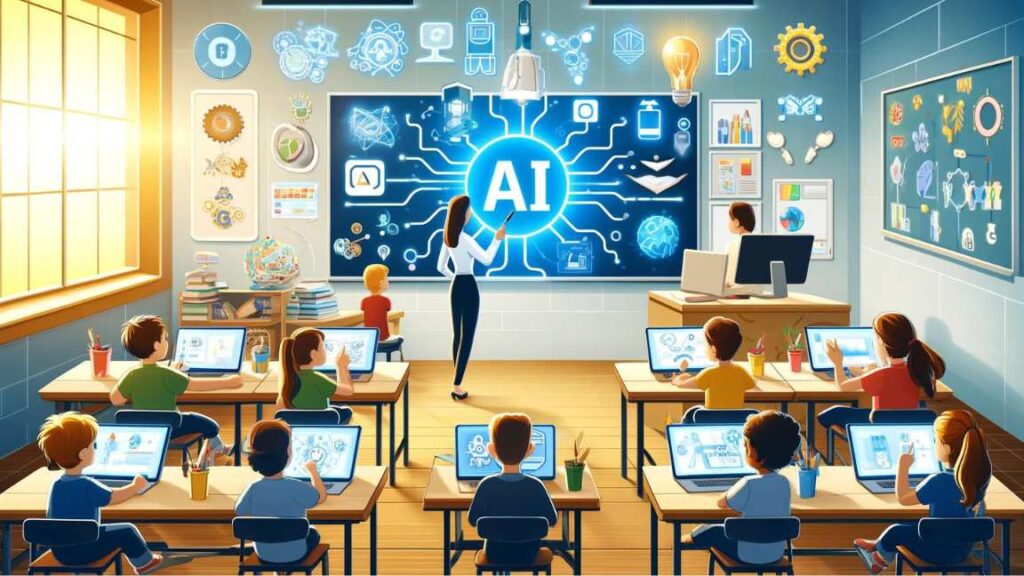
Walk into a classroom using AI learning tools and you’ll see something that looks both familiar and strange. Students still sit at desks. A teacher still circulates, answering questions and providing guidance. But the lesson each student experiences is uniquely theirs.
A middle school math teacher in Chicago described her experience: students work through lessons on tablets while she monitors a dashboard showing each student’s progress in real-time. The AI flags when someone is struggling with a particular concept, and she can intervene immediately rather than discovering the problem weeks later on a test. Advanced students move ahead without waiting, while others get additional practice and alternative explanations tailored to their needs.
The teacher’s role hasn’t diminished—if anything, it’s become more important and more human. Instead of spending energy delivering the same lecture repeatedly, she focuses on the aspects of teaching that actually require human judgment: recognizing when a student is frustrated, explaining concepts in new ways, fostering discussion, building relationships, and addressing the social-emotional aspects of learning that no algorithm can handle.
Language Learning Gets Personal
Language learning apps have become one of the most visible successes of educational AI. Apps like Duolingo use sophisticated algorithms to determine which words you’re struggling with, when you’re most likely to forget vocabulary, and what types of exercises work best for you.
The AI tracks thousands of data points: which words you consistently misspell, what time of day you practice most effectively, how long you can focus before accuracy drops, which grammatical structures cause confusion. It uses this data to create a learning experience that adapts continuously.
What makes this powerful isn’t just personalization but persistence. The app reminds you to practice, celebrates streaks, and makes lessons short enough to fit into a coffee break. It gamifies learning in ways that keep people engaged long enough to actually acquire language skills, something traditional classes struggle with once the semester ends.
Does it replace immersion or classroom instruction? No. But it provides accessible, personalized practice that would have been impossible without AI, and millions of people are learning languages who might never have enrolled in a formal class.
The Writing Tutor That Never Sleeps
AI writing assistants are changing how students learn to write, though not always in ways educators expected. Yes, some students use them to cheat, having AI generate entire essays. But more interesting are the students using AI as a writing coach.
A high school English teacher told me about students who draft essays, run them through AI feedback tools, revise based on suggestions, and repeat the process multiple times before submitting. The AI catches grammar issues, identifies unclear arguments, suggests stronger vocabulary, and points out logical gaps. Students learn by seeing specific feedback on their actual writing rather than generic advice.
The concern, valid enough, is that students might become dependent on AI feedback rather than developing internal editing skills. But proponents argue this is similar to how calculators didn’t eliminate the need to understand math—they just changed what skills matter most. Students still need to generate ideas, structure arguments, and make rhetorical choices. The AI helps with technical execution and iterative improvement.
Special Education Gets More Special
Perhaps the most promising application of AI in education is supporting students with learning differences. AI-powered tools can provide accommodations that would be impractical for teachers to deliver manually to every student who needs them.
Text-to-speech and speech-to-text tools help students with dyslexia or visual impairments. AI can adjust reading difficulty, presentation speed, or interface design to accommodate different processing speeds and attention spans. For students on the autism spectrum, some programs use AI to break down social situations and provide practice with facial recognition and emotional understanding in low-pressure digital environments.
These tools don’t replace special education teachers or therapists, but they extend the support available beyond one-on-one sessions, giving students more opportunities to practice skills in contexts where immediate human feedback isn’t available.
The Flip Side: What Gets Lost
As with most technology, the benefits come with trade-offs and concerns. Students spending more time with screens means less time with humans, and there’s something lost in that exchange. Learning to navigate disagreement with a peer, to ask questions in front of others, to explain your thinking out loud—these social aspects of education matter and they don’t happen through an interface.
There’s also the risk of over-optimizing for measurable outcomes. AI can effectively teach things that can be quantified: vocabulary retention, math accuracy, reading speed. It’s less equipped to foster creativity, critical thinking, or the kind of deep engagement with ideas that doesn’t produce neat data points.
Data privacy is another legitimate concern. Educational AI systems collect enormous amounts of data about how children think and learn. Who owns that data? How long is it kept? What happens if it’s breached or misused? These aren’t hypothetical concerns—they’re active questions without clear answers.
What Teachers Actually Think
Talk to teachers about AI in education and you’ll get a wide range of responses. Some are enthusiastic early adopters who see AI as finally providing tools to reach every student. Others are skeptical, worried about screen time, data privacy, and technology companies profiting from education.
Most fall somewhere in the middle: cautiously optimistic about potential benefits, frustrated with implementation challenges, and acutely aware that technology alone won’t solve the fundamental problems facing education—inadequate funding, overcrowded classrooms, social inequality, and the complexity of human development.
The teachers getting good results tend to view AI as one tool among many, not a replacement for human instruction. They use it strategically for tasks where personalization and immediate feedback matter, while preserving time for discussion, collaboration, hands-on projects, and the relationship-building that remains central to effective teaching.
Learning to Learn Differently
What we’re witnessing isn’t just new tools for old methods—it’s the emergence of genuinely different learning experiences. Students who grow up with AI tutors available on demand, with lessons that adapt to their pace, with immediate feedback on every attempt, will develop different expectations about what learning looks like.
Whether that’s entirely positive remains to be seen. But the genie isn’t going back in the bottle. AI in education will continue developing, spreading, and shaping how the next generation learns. The question worth asking isn’t whether to use these tools but how to use them thoughtfully, in ways that enhance rather than diminish the human elements that make education meaningful.