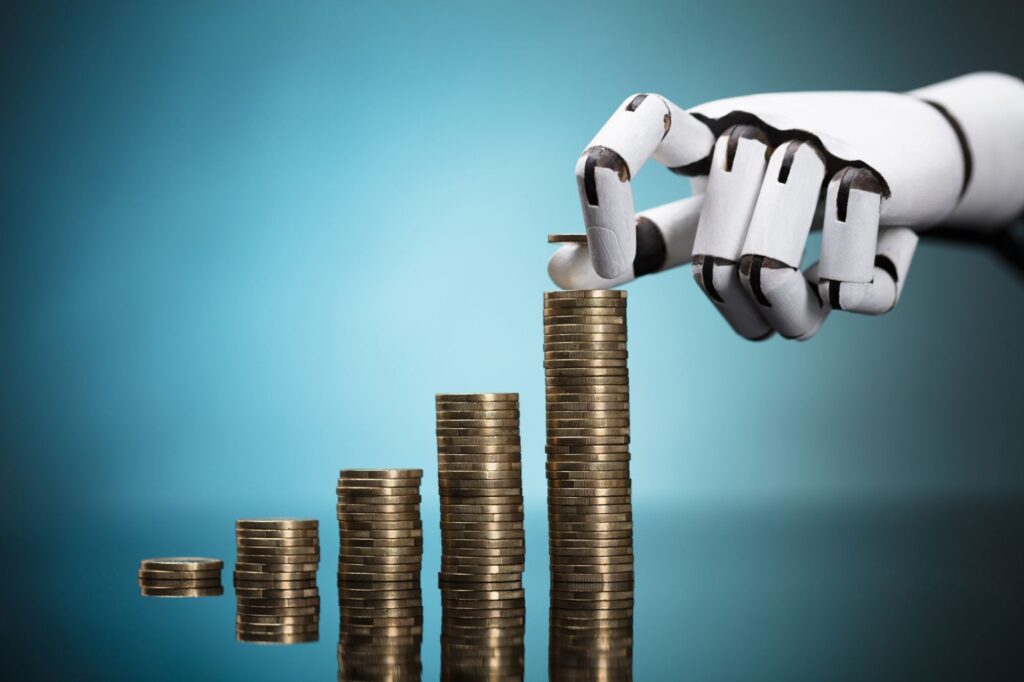
A banker friend recently mentioned that his job has changed more in the past three years than in the previous fifteen. Not because banking fundamentals shifted—money still moves the same way—but because the tools he uses to make decisions bear almost no resemblance to what he had before. “I used to spend weekends reviewing loan applications,” he said. “Now an AI flags the risky ones and I focus on the edge cases that actually need human judgment.”
This is finance in 2026: not robots replacing bankers, but algorithms handling the repetitive analytical work while humans focus on relationship management, complex decisions, and the situations that require contextual understanding that no system can replicate. The transformation is profound but less visible than you’d think, happening mostly behind the scenes in ways customers rarely notice directly.
Your Money, Managed by Algorithms
Robo-advisors have graduated from novelty to mainstream. These AI-powered investment platforms manage billions of dollars, automatically allocating assets, rebalancing portfolios, and optimizing for tax efficiency without human intervention. They’re not beating the market consistently—neither do most human advisors—but they’re performing adequately while charging a fraction of traditional management fees.
What makes them effective isn’t superior investment insight but disciplined consistency. They don’t panic sell during downturns. They don’t chase hot stocks based on hunches. They stick to the strategy, rebalance mechanically, and harvest tax losses automatically. It’s boring, systematic, and for most people’s needs, perfectly sufficient.
The interesting development is how traditional financial advisors are responding. Rather than being displaced, many are incorporating these tools into their practices. The AI handles routine portfolio management while advisors focus on financial planning, behavioral coaching during market volatility, and helping clients navigate major life transitions. It’s the same pattern we’re seeing across industries: automation of routine tasks, elevation of uniquely human contributions.
Fraud Detection That Never Sleeps
Credit card fraud detection was one of AI’s earliest successes in finance, and it keeps getting better. The system monitoring your transactions learns what’s normal for you specifically—where you shop, how much you typically spend, what time of day you use your card. When something deviates from your pattern, it gets flagged.
This sounds simple until you consider the complexity. False positives are costly and annoying—nobody likes having their card declined when traveling. False negatives mean fraud losses. The AI has to balance these risks for millions of customers simultaneously, adapting to changing fraud tactics in real-time.
Banks now detect fraud attempts that would have succeeded years ago. Criminals create increasingly sophisticated schemes, AI systems learn to recognize new patterns, criminals adapt again—it’s an ongoing arms race where AI’s ability to process vast transaction datasets and spot subtle anomalies provides a crucial edge.
The same technology extends to money laundering detection. AI analyzes transaction networks, identifying suspicious patterns that might indicate criminal activity: multiple small transfers designed to avoid reporting thresholds, circular money movements through shell companies, transactions that don’t match a business’s stated purpose. Human investigators still make final determinations, but AI dramatically narrows what they need to review.
Credit Decisions Get Complicated
AI credit scoring is simultaneously more accurate and more controversial than traditional approaches. Systems analyzing thousands of data points—not just credit history but also education, employment patterns, spending behaviors, even social media activity—can predict default risk more accurately than conventional FICO scores.
This creates opportunities for people previously excluded from credit. Someone with limited credit history but stable employment, consistent savings habits, and other positive indicators might get approved when traditional scoring would reject them. Immigrants, young people, and others building credit can access loans based on a broader assessment of creditworthiness.
But it also creates risks. When AI considers such expansive data, it can inadvertently discriminate based on proxies for protected characteristics. An algorithm might not explicitly consider race, but if it weighs factors like zip code, shopping patterns, or social connections that correlate with race, it achieves the same discriminatory effect through mathematical abstraction.
Regulators are struggling to keep up. How do you audit an AI lending decision for bias when the model considers interactions among thousands of variables in ways too complex for human interpretation? The answer isn’t clear yet, and the uncertainty makes some institutions cautious about deploying AI in lending despite its potential benefits.
Trading at Machine Speed
High-frequency trading—algorithms executing thousands of trades per second based on microscopic market inefficiencies—has been around for years. What’s changed is the sophistication. Modern AI trading systems don’t just execute predefined strategies; they adapt to market conditions, learning which approaches work in different environments.
These systems analyze not just price movements but news feeds, social media sentiment, satellite imagery of retail parking lots, weather patterns affecting agricultural commodities—any data that might predict price changes before they occur. The edge they seek is measured in milliseconds and fractions of a cent, but at sufficient scale, those tiny edges generate substantial profits.
For regular investors, high-frequency trading is mostly invisible, though there’s ongoing debate about whether it provides market liquidity or just extracts value from slower participants. Either way, it’s now a permanent feature of financial markets, and the arms race for faster, smarter trading algorithms continues.
Personal Finance Goes Conversational
Banking apps increasingly feature AI assistants that can answer questions about your finances conversationally. “Why was my water bill higher this month?” “Am I on track with my savings goal?” “What did I spend on restaurants last month?” The AI pulls relevant transaction data and provides context in natural language.
These assistants are also getting proactive. They notice irregular charges that might be forgotten subscriptions. They identify opportunities to save by switching utility providers. They warn when account balances might be insufficient to cover upcoming bills. Some even negotiate bills on your behalf, using AI to navigate customer service systems and request discounts.
This is financial management becoming less about spreadsheets and more about conversational guidance. It’s not as sophisticated as a human financial advisor, but it’s available instantly, costs nothing, and for basic money management questions, it’s often sufficient.
The Insurance Equation Changes
Insurance has always been about risk assessment, making it natural territory for AI. Insurers now use algorithms that consider far more factors than traditional actuarial tables: how you drive based on telematics data, your health metrics from wearable devices, even satellite imagery of your property to assess wildfire or flood risk.
This enables more precise pricing. Safe drivers pay less for auto insurance. Healthy people get better life insurance rates. Homeowners who maintain their properties pay less than those who don’t. In theory, this is fairer—why should cautious drivers subsidize reckless ones?
In practice, it creates uncomfortable dynamics. Privacy-conscious people who don’t share data pay higher rates, effectively penalized for not participating in surveillance. People in disadvantaged circumstances—living in neighborhoods with higher crime, unable to afford home maintenance—face higher premiums that compound existing inequalities.
Market Predictions and Portfolio Construction
AI systems analyze market data looking for patterns that might predict future movements. They’re not consistently beating the market—nobody is—but they’re finding correlations humans would miss. A particular combination of yield curve movements, sentiment indicators, and sector rotations that historically preceded downturns. Supply chain signals that predict earnings surprises before they’re announced.
Hedge funds employ AI researchers alongside traditional quants, building models that process alternative data sources: credit card transactions hinting at consumer spending trends, location data suggesting retail foot traffic, job postings indicating company growth plans. The competition is finding signal in datasets competitors haven’t thought to analyze yet.
For institutional investors, AI assists with portfolio construction, optimizing asset allocation not just for expected returns but for complex objectives: maximizing returns while limiting downside risk, maintaining specific factor exposures, minimizing transaction costs and tax impact, staying within regulatory constraints. These multi-objective optimization problems are exactly what AI handles well.
The Trust Problem
Finance runs on trust, and AI introduces new uncertainties. When an algorithm rejects your loan application, you deserve an explanation, but “the model said so” isn’t satisfying. When your investment portfolio underperforms, you want to understand why, but complex AI strategies can be difficult to explain even to sophisticated investors.
Financial institutions are learning they need to balance AI sophistication with explainability. The most accurate model isn’t useful if customers don’t trust it or regulators can’t audit it. This is pushing development toward interpretable AI—systems that can articulate their reasoning in ways humans can evaluate.
The regulatory environment is evolving slowly, trying to address AI without stifling innovation. But gaps remain, particularly around algorithmic accountability, bias in automated decisions, and consumer protections when AI makes financial determinations.
The future of finance is undoubtedly more AI-driven, but success will require building systems that are not just intelligent but trustworthy, not just efficient but fair, not just profitable but aligned with broader social values. Getting that balance right might be the hardest financial problem AI has yet to solve.