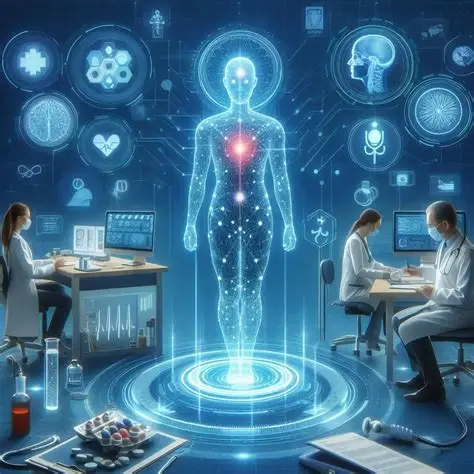
A radiologist in Boston recently told me about a moment that stuck with her. She was reviewing chest X-rays at the end of a long shift when the AI system flagged an image she’d initially cleared. She looked again, more carefully this time, and spotted a tiny nodule she’d missed—early-stage lung cancer, still treatable. “The AI didn’t make the diagnosis,” she said. “I did. But it made me look twice when I was tired and might have missed it.”
That’s the promise of AI in healthcare, and it’s not quite what the headlines suggest. We’re not talking about robot doctors replacing human physicians. We’re talking about tools that catch things humans miss, process information faster than any person could, and free up medical professionals to focus on what they do best: talking to patients, making complex judgments, and providing care that requires empathy and experience.
Diagnosis Gets a Second Opinion
Medical imaging is where AI has made the most tangible impact. Radiologists, pathologists, and dermatologists now work alongside AI systems that have been trained on millions of images to recognize patterns associated with disease.
An AI examining a mammogram can spot suspicious patterns that might indicate breast cancer, flagging cases for closer human review. Systems analyzing skin lesions can identify potential melanomas with accuracy comparable to experienced dermatologists. Pathology AI can scan tissue samples and identify cancerous cells, sometimes catching abnormalities that human eyes overlook.
The key word here is “alongside.” These systems aren’t replacing doctors—they’re functioning as highly specialized assistants that never get tired, never lose focus, and can process vast amounts of visual data without the cognitive fatigue that affects humans after hours of looking at similar images.
A pathologist described it as having a colleague who’s seen every rare cancer variant ever documented but lacks common sense. The AI might flag something unusual that turns out to be clinically irrelevant, or miss something obvious if it wasn’t well-represented in training data. Human expertise remains essential, but the combination of human judgment and AI pattern recognition is proving more effective than either alone.
Drug Discovery Accelerates
Developing new medications traditionally takes over a decade and costs billions of dollars. Much of that time is spent on the tedious process of identifying promising molecular compounds, testing them, watching most fail, and starting over.
AI is compressing parts of this timeline dramatically. Machine learning systems can analyze the properties of millions of potential compounds and predict which ones are likely to bind to specific disease targets. They can simulate how molecules will behave in the body without running actual experiments. They can identify existing drugs that might be repurposed for new conditions.
During the COVID pandemic, AI-assisted research helped identify promising vaccine candidates and existing drugs worth testing against the virus. What might have taken years took months. The vaccines still required traditional clinical trials—AI can’t replace the need to verify safety and effectiveness in humans—but it dramatically accelerated the early research phases.
Smaller biotech companies are now using AI to compete with pharmaceutical giants, identifying drug candidates with tiny research teams that would have been impossible before these tools existed. It’s not making drug development cheap or easy, but it’s making it faster and more accessible.
Predicting Problems Before They Happen
Perhaps the most interesting application of healthcare AI is predictive analytics—using patient data to identify problems before they become acute.
Hospitals are deploying AI systems that monitor patients continuously, looking for subtle patterns that precede serious complications. A slight change in heart rate variability combined with minor shifts in blood pressure might indicate sepsis developing hours before obvious symptoms appear. Early intervention can be the difference between full recovery and organ failure.
For chronic disease management, AI analyzes patterns in glucose levels, activity, diet, and other factors to help diabetics predict blood sugar crashes before they happen. Heart disease patients use apps that monitor symptoms and vital signs, alerting them and their doctors to concerning changes that might indicate a problem developing.
The promise is moving from reactive to preventive care—catching problems early when they’re easier and cheaper to treat. The challenge is doing this without creating alarm fatigue, where so many alerts are false positives that doctors and patients start ignoring them.
The Administrative Time Sink
One of the less glamorous but potentially most impactful uses of AI in healthcare has nothing to do with diagnosis or treatment. It’s administrative work.
Doctors spend absurd amounts of time on documentation, entering data into electronic health records, coding diagnoses for billing, and filling out forms. Some estimates suggest physicians spend twice as much time on paperwork as actually talking to patients.
AI-powered transcription systems can now listen to doctor-patient conversations and automatically generate clinical notes, pulling out relevant information and organizing it appropriately. Natural language processing extracts key details from medical records that would take humans hours to review. AI assists with medical coding, the tedious process of translating diagnoses and procedures into standardized codes for billing and insurance.
These applications won’t make headlines, but they might do more for healthcare than any diagnostic algorithm. Reducing administrative burden means doctors can see more patients, spend more time with each one, and maybe go home at a reasonable hour instead of staying late to finish paperwork.
A primary care physician told me he was skeptical about AI in medicine until his clinic implemented an AI documentation system. “I’m making eye contact with patients again instead of typing into a computer while they talk,” he said. “It sounds small, but it’s changed how I practice.”
Personalized Medicine Gets More Personal
AI is enabling treatment approaches tailored to individual patients rather than broad population averages. Oncologists use AI systems that analyze a patient’s specific tumor genetics, medical history, and treatment responses to recommend therapies most likely to work for that particular cancer.
AI can predict which medications a patient is likely to tolerate based on their genetic profile, potentially avoiding trial-and-error approaches to finding effective treatments. It can estimate surgery risks for specific individuals more accurately than general statistics.
This isn’t sci-fi personalized medicine where every treatment is custom-designed. But it’s a meaningful step beyond the current approach of trying standard protocols and adjusting if they don’t work.
The Problems Nobody Wants to Talk About
Healthcare AI has legitimate issues that enthusiastic coverage often glosses over. Training data is often biased—if an AI learns from data primarily from white patients, it performs worse on people of color. Diagnostic algorithms trained on images from expensive equipment don’t work as well with older machines common in underfunded hospitals.
There’s also the black box problem. Some AI systems make accurate predictions but can’t explain why, which creates challenges when doctors need to understand the reasoning behind a recommendation or defend a treatment decision. Medicine involves explaining risks and options to patients—”the AI said so” isn’t a satisfying answer.
Liability questions remain murky. If an AI misses a diagnosis, who’s responsible? The doctor who relied on it? The hospital that implemented it? The company that created it? These questions don’t have clear answers yet, which makes some providers hesitant to trust AI recommendations.
What Patients Actually Experience
For most patients, healthcare AI remains largely invisible. Your doctor might be using AI tools, but you probably wouldn’t know unless they mentioned it. The X-ray gets read, the diagnosis gets made, the treatment gets prescribed—the process looks the same from the patient’s perspective.
What you might notice is your doctor spending more time actually talking to you instead of typing. You might get a message from your healthcare app warning that your symptoms suggest you should seek care. You might have access to remote monitoring that lets you manage chronic conditions at home instead of frequent clinic visits.
The promise is healthcare that’s more accessible, more personalized, and more proactive. The reality is that we’re still in early days, with islands of impressive capability surrounded by vast areas where AI hasn’t made much difference yet.
But those islands are expanding. The radiologist who caught that lung cancer because an AI made her look twice? That patient is alive because of technology that didn’t exist five years ago. Multiply those moments across thousands of hospitals, millions of images, countless opportunities to catch disease early or avoid mistakes, and you start to see why healthcare providers are cautiously optimistic about where this is heading.