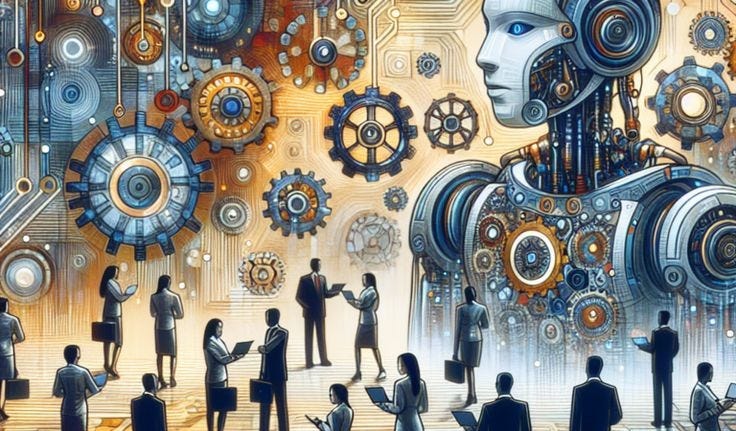
Walk into any office today and you’ll likely hear conflicting stories about AI. Someone’s convinced their job will be automated away by next year. Another person swears AI has made them twice as productive. A third is quietly using ChatGPT to draft emails while pretending nothing has changed. The truth, as usual, sits somewhere messier than any of these narratives suggest.
We’re living through one of those rare moments when the ground shifts beneath our feet, but we won’t fully understand what happened until years from now. The question isn’t whether AI is changing work—it obviously is—but rather how those changes are playing out in ways that matter to actual people trying to pay their mortgages and build careers.
Beyond the Headlines
The anxiety is understandable. Every few weeks brings another headline about AI achieving something previously thought impossible: passing professional exams, writing code, diagnosing diseases, creating marketing campaigns. It’s easy to extrapolate from these achievements to a future where human workers become obsolete.
But here’s what those headlines miss: they’re describing what AI can do in controlled environments, not what’s actually happening in messy, complicated workplaces. There’s a massive gap between “this technology exists” and “this technology has replaced human workers at scale.” That gap is filled with questions about cost, implementation, trust, regulation, and the thousand small ways that real work differs from the idealized scenarios AI companies demonstrate.
Take customer service, an area often cited as ripe for automation. Yes, AI chatbots have improved dramatically. But anyone who’s recently tried to resolve a complex problem with an automated system knows they still fall apart when confronted with anything outside their training. The result isn’t wholesale replacement of human agents but rather a reconfiguration: bots handle routine queries while humans deal with escalations and edge cases. The jobs haven’t disappeared; they’ve changed character, often becoming more challenging as workers handle only the difficult cases that stumped the AI.
The Transformation Nobody Talks About
What’s actually happening in most workplaces isn’t elimination but augmentation. Lawyers still practice law, but junior associates spend less time on document review because AI can flag relevant passages. Graphic designers still design, but they can iterate faster using AI tools to generate variations. Programmers still write code, but they have AI assistants to help with boilerplate and debugging.
This shift is significant but subtle. The work remains fundamentally human; the workflow changes. A marketing professional I know describes it well: “I spend less time staring at blank pages and more time editing, refining, and making strategic decisions about what message we’re actually trying to send.” Her job hasn’t been automated. It’s evolved to emphasize different skills.
The catch is that this evolution isn’t equally accessible or beneficial to everyone. Workers who can afford time to learn new tools, who have supportive employers, who possess baseline digital literacy—they’re often getting more productive and valuable. Meanwhile, workers in precarious positions, without training opportunities, or in organizations slow to adapt may find themselves falling behind through no fault of their own.
The Jobs We’re Not Talking About
While everyone focuses on whether AI will replace knowledge workers, something arguably more immediate is happening at other income levels. The rollout of automated checkout systems, algorithmic management in warehouses, and AI-enabled surveillance of workers is transforming jobs that were already difficult and often undervalued.
A warehouse worker now competes not just against productivity standards but against an algorithm that tracks their every movement and compares them to the theoretical optimal performance. A delivery driver’s route, timing, and customer interactions are monitored and analyzed by systems that don’t account for traffic accidents, difficult customers, or the basic human need for a bathroom break.
These changes don’t make headlines because they’re not flashy demonstrations of AI capability. They’re quiet intensifications of existing surveillance and management practices, made possible by cheaper and more capable AI systems. The jobs still exist, but the experience of doing them becomes more stressful and dehumanizing.
The Skills Question
Everyone seems to agree that workers need to “upskill” or “reskill” for an AI-enabled economy, but there’s far less agreement on what that actually means. The standard advice—learn to work with AI, focus on uniquely human skills like creativity and emotional intelligence—sounds reasonable until you try to operationalize it.
What does it mean to “learn to work with AI” when the tools change every six months? Which creative skills matter when AI can generate decent first drafts of almost anything? How do you build a career on emotional intelligence in an economy that’s been systematically devaluing interpersonal work for decades?
The honest answer is that nobody really knows yet. We’re in an experimental phase where different approaches are being tried, some will work, many won’t, and the patterns will only become clear in retrospect. That’s uncomfortable for people trying to make career decisions today, but it’s the reality.
What seems increasingly clear is that pure technical skills aren’t enough. The ability to prompt an AI effectively matters less than understanding what questions to ask in the first place, recognizing when AI outputs are subtly wrong, and knowing how to integrate AI-generated material into work that serves actual human needs and values.
The Power Dynamics
One aspect that doesn’t get enough attention is how AI is shifting power dynamics in the workplace. When a company adopts AI tools, who benefits from the resulting productivity gains? Do workers get higher pay, reduced hours, or better conditions? Or do the gains flow primarily to shareholders and executives while workers face the same pressures with fewer colleagues?
Early evidence suggests the latter is more common. Companies trumpet efficiency gains but rarely pass those benefits to the workers who are now managing AI systems alongside their regular duties. Instead, we see what economists call “productivity-pay divergence”—workers produce more value, but compensation doesn’t increase proportionally.
There’s also the question of who controls the AI and its outputs. If you use an AI tool to write a report, who owns that work? If AI suggestions shape your decisions, who’s accountable for the results? These aren’t abstract legal questions—they have real implications for job security, intellectual property, and professional responsibility.
Looking Forward Without Crystal Balls
Predictions about AI and employment tend to fall into two camps: utopian visions of abundance and leisure, or dystopian warnings of mass unemployment and social collapse. Reality will almost certainly be more boring and complicated than either extreme.
What we’re likely facing is a prolonged period of disruption and adaptation. Some jobs will disappear, especially those involving routine information processing. New jobs will emerge, many of them in fields we can’t yet imagine. Most jobs will transform in ways that make them simultaneously more productive and more demanding.
The question that matters isn’t “Will AI take my job?” but rather “How can we ensure that AI-driven changes to work improve human lives rather than just making businesses more profitable?” That’s fundamentally a political and social question, not a technological one. The technology will continue advancing regardless. What remains up for debate is how we choose to deploy it, who benefits from it, and what protections we put in place for workers navigating this transition.
The future of work in an AI age won’t be determined by algorithms and neural networks. It will be determined by the choices we make—as individuals, organizations, and societies—about what kind of working lives we want to build with these powerful new tools.