
Machines are really good at making things like pictures and stories. They do this with something called Generative AI. Let me tell you about Generative AI.
Generative AI is a way that machines can create content. This means that machines can make things like pictures, music and even whole stories. It is pretty cool that machines can do this.
Machines use computer programs to make this content. These programs are very good at looking at things that people have made and then making something that is similar. For example if a machine looks at a lot of pictures of dogs it can then make its picture of a dog.
People use Generative AI for a lot of things. They use it to make pictures and videos for movies and television shows. They also use it to make music and write stories. Generative AI is very helpful for people who make things like movies and music.
I think Generative AI is really interesting. It is amazing that machines can make things that’re so similar, to what people make. I am excited to see what other things machines will be able to make with Generative AI.
Recently something big has happened in the world of technology. It is the rise of artificial intelligence. Generative artificial intelligence systems can make things like text that makes sense pictures that look real music that is nice to listen to and videos that are interesting to watch. People are really interested in artificial intelligence and it is changing a lot of industries. So how do these machines that can make things work? What is the reason they seem amazing? Generative artificial intelligence is really making people think about what’s possible, with technology.
What is Generative AI?
Generative AI is a part of intelligence that makes new things. It does not just look at information or put things into categories. Instead generative AI creates things like text, pictures, sounds and code. This is different from artificial intelligence systems that just find patterns or make choices based on information. Generative AI can make things that people used to have to make themselves like stories or music. It is really good at making content that is similar, to what people can make. Generative AI is very useful because it can make a lot of things that are interesting and helpful.
What’s fascinating about these systems is that they don’t simply copy or rearrange existing content. Instead, they learn the underlying patterns, structures, and relationships in large training datasets and then use that knowledge to generate something entirely new. It’s as if a student learned the rules of grammar, vocabulary, and writing styles by reading thousands of books, and then was able to write their own original stories.
The Fundamentals: Neural Networks and Deep Learning
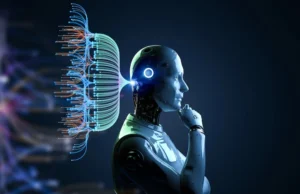
To understand how generative AI works we have to look at neural networks. These networks are of like the human brain. They are made up of layers of points which we call artificial neurons that work together to figure out information. Each connection between these neurons has a weight, which’s, like a measure of how much one neuron can affect another neuron. The artificial neural networks are really important to understand how generative AI works.
Deep learning is a part of machine learning. It uses something called networks that have a lot of layers which is why we call it “deep”. When deep learning is being trained it looks at millions or even billions of examples. It keeps changing the connections between these examples to get better at what it does. This is of like how people learn things. People learn from what happens to them. They get better at things when they do them a lot and get feedback. Deep learning works in a way, to how people learn.
Language Models: Text Creation
Large language models are really something. They are one of the things to come out of artificial intelligence that can make things. These systems are trained on an amount of text from the internet, books and articles. They learn about the language people use, like grammar and syntax. Large language models also learn about what words mean and how people use them in situations. They even learn about the culture, behind the language. Large language models learn all of this and a lot more.
The model does a thing. It tries to figure out what word comes next in a sentence. It does this by looking at the words that came before. This sounds easy. When you make it really big like with a huge number of things that can be changed it gets really good at it. The model can make sense when it talks, think about things write in different ways and it even knows a lot about certain subjects. The model can do all these things because it is really good at predicting the word in a sequence. The model is very good, at this.
The transformer architecture that came out in 2017 changed everything. It let models look at parts of a sequence at the same time and understand how they are all connected. The transformer architecture has something called attention mechanisms. These attention mechanisms help the transformer architecture figure out what is important, in the input text. The transformer architecture uses these attention mechanisms to focus on the important parts when it is generating each new word in the transformer architecture.
Image Generation: From Noise to Reality
AI image generation uses some cool methods. The thing about diffusion models is that they are the way to make high quality images now. They do this in a way that’s a little weird: they figure out how to get rid of the noise. AI image generation is a big deal and diffusion models are a part of it. They are good, at making images that look real. That is because they learn to remove noise from the images.
When the model is being trained it looks at pictures and slowly adds random noise to them until they are just a bunch of static. Then it figures out how to undo this process taking away the noise a little at a time to get the picture back. After the model is trained it can start with random noise and use a description of what the picture should be to slowly take away the noise and show an image that matches what the description says about the picture. The model can take the noise and make it into a real picture that looks like what the description of the picture says the picture should look like.
This thing happens in a lot of steps. Each step makes the picture a little better. It starts out messy. Then it gets clearer. The pictures that come out can be really detailed. Look real. Or they can be really creative and crazy it just depends on what the person making it tells it to do. The images can be surprisingly detailed and realistic or the images can be fantastically creative.
Generative Adversarial Networks work in a simple way. They have two parts that work against each other. One part, the generator makes pictures. The other part, the discriminator tries to figure out if a picture is real or if the generator made it. When these two parts compete with each other they both get better and better. This means that the pictures the generator makes start to look more and more real. Generative Adversarial Networks are really good, at this. They can make pictures that look very real.
Audio and Music: Synthetic Symphonies
Generative AI is really good, at making audio and music. It can make voices that sound like people are talking. Generative AI can also make music in different styles.. It can even make special sounds that people need. Generative AI is getting better at making music and audio that sounds real.
When it comes to music generation some models look at patterns in songs that already exist. They learn about the structure of the music like the rhythm and the melody. They also learn about the chords. How they work together. Then they can make music that sounds like it follows the rules but is still something new.
Other systems let people choose things like how they want the music to sound how fast or slow it should be, what instruments should be used and what kind of music it should be. These systems make music that is tailored to what the people want music generation is really about making music that people like music generation is, about creating music that is original and follows the rules of music generation.
Voice synthesis is really good now it is very hard to tell if you are hearing a persons voice or a computer generated voice. This is useful for things like helping people who have trouble speaking making movies where the voices need to be changed and virtual assistants like the ones, on our phones. Voice synthesis has a lot of uses too.. At the same time voice synthesis is also a problem because it can be used to make fake voices that sound real, like deepfakes and that can cause a lot of confusion and people can be misled by false information. Voice synthesis is something that can be used for good or bad it depends on how people use voice synthesis.
The Training Process: A Massive Undertaking
Training these AI models is a really big job. It needs a lot of computer power. The best models are trained using thousands of computer chips like GPUs or TPUs, for weeks or even months. This uses a lot of energy as much as hundreds of homes use in a year. Training AI models is a huge task that requires a lot of computer power and energy.
The training data for these models is really huge. Language models are trained on a number of words we are talking about trillions of words. On the hand image generation models look at billions of pairs of images and text that go with them. The training data has to be good it has to be different. There has to be a lot of it. This is very important for the language models and the image generation models to be good at what they do. The quality of the training data the diversity of the training data and the quantity of the training data are all crucial, for the resulting language models and the resulting image generation models.
When the model is being trained it tries to make guesses then it checks how good those guesses are by looking at the results and it changes what is inside to make fewer mistakes. The model does this over and over, with all the training information. This helps the model get a better understanding of things.
Limitations and Challenges
Generative AI is really good at what it does.. It has some big problems. These models can make things up which is called “hallucinate”. This means they give information and they sound like they are totally sure, about it. The thing is, generative AI does not really understand the world. It just looks at the information it was trained on. Finds patterns. Generative AI works with these patterns. It does not know what is really going on.
Biases in the training data will always show up in the models outputs. If the data has stereotypes or if it does not have a balance of perspectives the model will do the same thing. The model will repeat what it has learned from the training data. So we have to deal with these biases in the training data and the model. Dealing with biases in the model is a problem that people are still trying to solve. Biases, in the model are a challenge that people are working on all the time.
The question of creativity is still not answered. These systems can make things but are they really being creative or are they just putting together things they already know in ways that make sense most of the time? The idea of creativity is what we are talking about here and that is still a mystery. Are these systems just mixing and matching things from what they learned or is something going on with creativity?
Transformative Practical Applications
Despite these limitations, applications of generative AI are proliferating rapidly. In marketing, it generates personalized content at scale. In software development, it assists programmers by writing code and detecting errors. In medicine, it contributes to drug discovery by generating new candidate molecules. In design, it enables rapid iteration of visual concepts. In education, it provides personalized tutoring and generates tailored learning materials.
The Future of Creation
Generative AI is a change in how we interact with technology and creativity. We are moving away from tools that just make things we do better to systems that can actually work with us to create things. This does not mean that humans will not be creative anymore. Rather that the way we are creative will change. Generative AI will help us to be more creative, in ways.
The future will probably have humans and Artificial Intelligence working together closely. Humans are good at thinking about what they want to do and making decisions based on the situation. They also understand feelings well and know what it is like to live a life. Artificial Intelligence is good at doing things and remembering everything. It can try different things in a short time and look at a lot of information. Humans and Artificial Intelligence will help each other because humans are good at some things and Artificial Intelligence is good at things. Artificial Intelligence will do things that humansre not good at and humans will do things that Artificial Intelligence is not good, at. This way humans and Artificial Intelligence will work together.
Knowing how these systems work is really important. Generative AI is becoming a part of our work and personal life. If we understand what it can and cannot do and how it works inside we can use it better. We can also ask the questions when we get results, from it.. When people talk about how it should be controlled and made better we can join in the conversation and know what we are talking about.
The era of creative machines is just beginning, and it promises to be as challenging as it is exciting.