
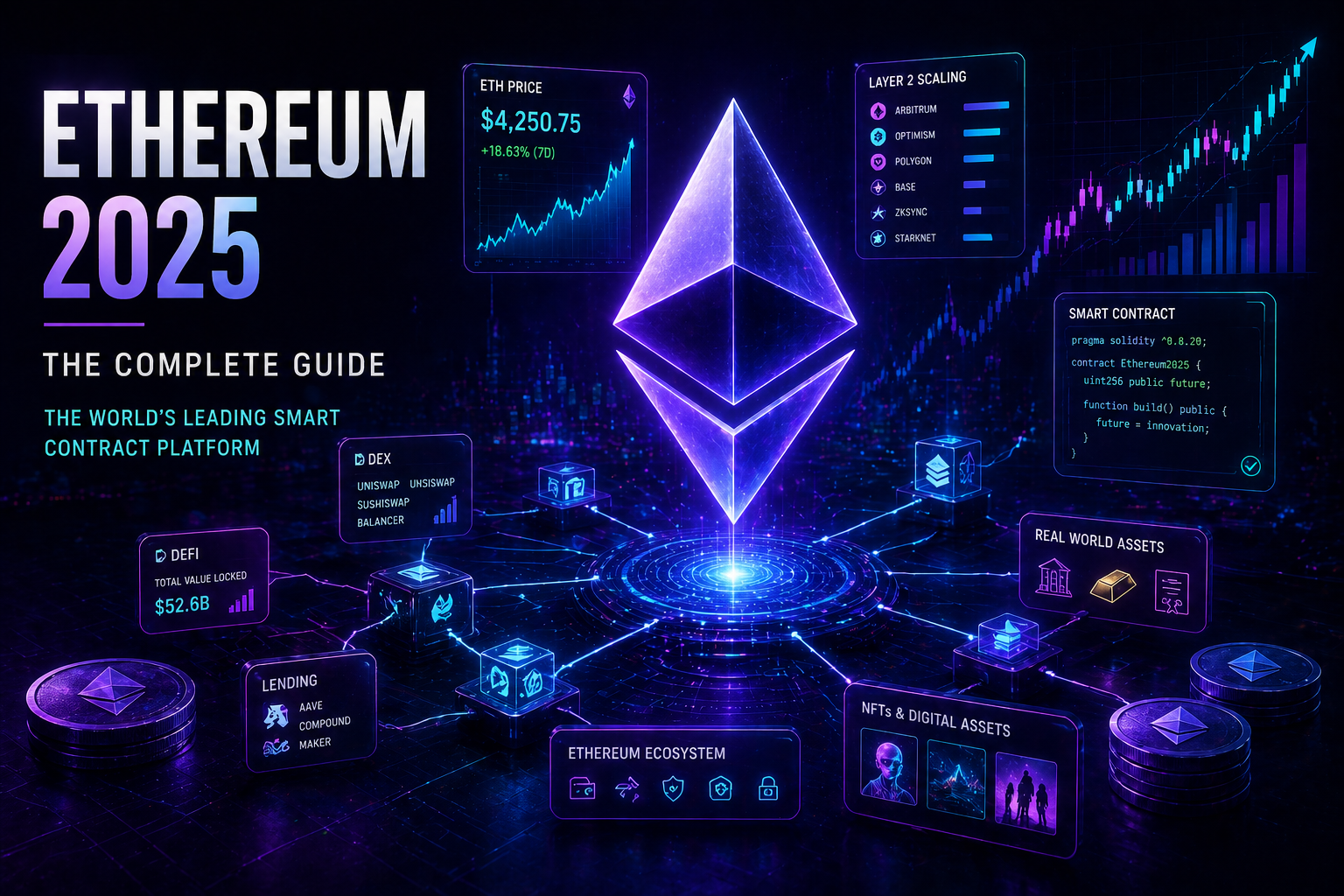
Ethereum is more than a cryptocurrency. It is a programmable blockchain platform that has become the foundational infrastructure for a vast ecosystem of decentralized applications — from financial protocols managing hundreds of billions in assets to NFT marketplaces, gaming platforms, and decentralized governance systems. In terms of developer activity, total value locked, and application diversity, Ethereum remains the dominant smart contract platform by a substantial margin. Understanding Ethereum means understanding not just a digital asset, but an entirely new paradigm for how contracts, ownership, and financial transactions can work on the internet.
In this comprehensive guide, you will learn what makes Ethereum unique, how it works technically, what the major upgrades have changed, how its ecosystem has evolved through 2025, and how to evaluate it as a long-term investment with a clear understanding of both the opportunity and the risks.
What Is Ethereum?
Ethereum is an open-source, decentralized blockchain network launched in 2015 by Vitalik Buterin and a team of co-founders including Gavin Wood, Joseph Lubin, and Charles Hoskinson. Like Bitcoin, it uses a distributed ledger maintained by thousands of nodes around the world with no central authority. Unlike Bitcoin — which was designed primarily as a peer-to-peer electronic currency — Ethereum was built as a programmable platform capable of executing complex code stored on the blockchain in the form of smart contracts.
Smart contracts are self-executing programs that automatically carry out predefined actions when specific conditions are met — without requiring any trusted third party to enforce them. Once deployed on Ethereum, they run exactly as programmed, cannot be altered, and are fully transparent to anyone with internet access. This innovation has enabled entire categories of financial and digital products that did not previously exist: decentralized exchanges, lending protocols, stablecoins, yield optimization tools, and programmable ownership of digital assets.
The native currency of the Ethereum network is Ether (ETH), used to pay for computational resources (gas fees) and as a store of value. ETH is also staked to secure the network under Proof of Stake, used as collateral in DeFi protocols, and burned through the EIP-1559 fee mechanism.
How Ethereum Works: The Technical Foundation
The Ethereum Virtual Machine (EVM)
The Ethereum Virtual Machine is the computational engine that executes smart contracts. Every full node in the Ethereum network runs the EVM, ensuring that all nodes reach identical outcomes when processing the same transactions. This distributed computation is what makes Ethereum both trustless and censorship-resistant — no single party controls which transactions are processed or how smart contracts execute. The EVM processes transactions sequentially within each block, with each block containing a set of validated transactions.
The EVM’s design has become highly influential: many competing blockchains (Polygon, Avalanche, BNB Chain, and others) have built EVM-compatible environments to allow developers to deploy Ethereum-compatible smart contracts on their networks, creating a broad ecosystem of interoperable chains that share Ethereum’s developer tooling and programming languages.
Gas and Transaction Fees
Every operation on Ethereum consumes computational resources, measured in units called “gas.” Users pay gas fees in ETH to compensate validators for the computational work involved. Complex smart contract interactions — like a multi-step DeFi transaction — consume significantly more gas than a simple ETH transfer.
Gas prices fluctuate with network demand: during high-activity periods (major NFT launches, DeFi opportunities, or market volatility), fees can spike dramatically — sometimes reaching $50–$200+ for a single complex transaction on the Ethereum mainnet. This fee volatility has been one of Ethereum’s most persistent user experience challenges and the primary driver of adoption for Layer 2 solutions.
Proof of Stake: The Merge and Its Consequences
In September 2022, Ethereum completed “The Merge” — arguably the most significant upgrade in blockchain history. The network transitioned from energy-intensive Proof of Work (PoW) mining to Proof of Stake (PoS) consensus, reducing the network’s energy consumption by approximately 99.95%. This addressed one of Ethereum’s most persistent criticisms and removed a major barrier to institutional and environmental-mandate-sensitive adoption.
Under PoS, validators stake 32 ETH as collateral to participate in transaction validation. They earn staking rewards — currently approximately 3–5% annually — and risk having a portion of their stake “slashed” for dishonest behavior. As of 2025, over 30 million ETH — roughly 25% of the circulating supply — is staked by validators worldwide. This massive locked supply creates persistent buy-and-hold demand from validators and meaningfully reduces the effective circulating supply available for trading.
Ethereum’s Deflationary Mechanism: EIP-1559 and the ETH Burn
In August 2021, Ethereum implemented EIP-1559, fundamentally changing how transaction fees work. Under this mechanism, each transaction includes a “base fee” that is permanently burned (destroyed) rather than paid to validators. Validators receive only a small “priority fee” (tip) from users who want faster inclusion.
The economic consequence is profound: during periods of high network activity, ETH is burned faster than it is created through staking rewards, making ETH net deflationary. Since The Merge reduced issuance by approximately 90% (from ~13,000 ETH per day under PoW to ~1,700 ETH per day under PoS) and EIP-1559 burns a portion of all fees, Ethereum has experienced net deflationary supply conditions during many high-activity periods.
This “ultrasound money” narrative — ETH becoming increasingly scarce as it is used — represents a fundamental shift in Ethereum’s investment case. Unlike Bitcoin’s fixed supply, ETH’s supply dynamics are usage-driven: the more the Ethereum network is used, the more ETH is burned. As network adoption grows, deflationary pressure increases proportionally.
The Ethereum Ecosystem in 2025
Decentralized Finance (DeFi)
DeFi remains the most economically significant application category built on Ethereum. Uniswap — the largest decentralized exchange — processes billions in trading volume weekly, allowing anyone to trade ERC-20 tokens without a centralized intermediary. Lending protocols like Aave and Compound allow users to borrow and lend crypto assets with algorithmically determined interest rates and no credit checks. Yield optimization platforms like Yearn Finance automatically move assets across protocols to maximize returns. For a broader introduction to DeFi, see our guide on DeFi in 2025.
Layer 2 Scaling: Ethereum’s Most Important Evolution
One of the most transformative developments in the Ethereum ecosystem through 2024–2025 has been the explosive growth of Layer 2 (L2) networks. These are separate blockchains that process transactions off the Ethereum mainchain (Layer 1) and periodically “settle” their compressed transaction batches back to Ethereum mainchain, inheriting its security guarantees.
The results have been dramatic. Leading L2s include:
- Arbitrum: The largest Ethereum L2 by total value locked, handling millions of transactions at a fraction of mainnet costs. Users pay fees of $0.01–$0.10 per transaction versus $2–20+ on mainnet.
- Optimism / Base: Base is Coinbase’s L2 built on Optimism’s technology stack and has become one of the fastest-growing L2s, driven by retail adoption and Coinbase’s distribution reach.
- zkSync and StarkNet: Zero-knowledge proof-based L2s that offer even stronger mathematical security guarantees than optimistic rollups, at the cost of greater technical complexity.
The L2 scaling architecture has fundamentally changed the Ethereum ecosystem’s economics: routine transactions happen cheaply on L2s, while Ethereum mainnet serves as the settlement and data availability layer. This positions Ethereum as a foundational infrastructure layer rather than a direct competitor to fast, cheap blockchains.
NFTs and Digital Ownership Beyond the Hype
Non-fungible tokens (NFTs) on Ethereum saw explosive mainstream adoption in 2021 and have since evolved well beyond the speculative art market that dominated early headlines. In 2025, NFT technology underpins event ticketing systems (eliminating fraud and scalping through verifiable ownership), gaming asset ownership (allowing players to truly own in-game items and transfer them between games), real-world asset tokenization, and digital identity verification. Ethereum remains the dominant NFT issuance platform by both volume and brand value.
Real-World Asset Tokenization
One of the most significant growth areas for Ethereum in 2024–2025 has been the tokenization of real-world assets (RWAs) — representing ownership of real financial instruments on-chain. U.S. Treasury bonds, corporate credit, private equity, real estate, and commodities are increasingly being tokenized on Ethereum, allowing for programmable, 24/7 transferability with blockchain-based settlement. BlackRock’s BUIDL fund — a tokenized Treasury money market fund on Ethereum — crossed $500 million in assets within months of launch, signaling institutional confidence in Ethereum as financial infrastructure. For more on asset tokenization, see our article on Asset Tokenization.
Ethereum vs. Bitcoin: Different Investment Theses
Bitcoin and Ethereum are frequently compared, but they serve fundamentally different purposes and represent distinct investment theses. Bitcoin is primarily positioned as digital gold — a scarce, decentralized store of value with a fixed 21 million coin supply and minimal programmability. Its value proposition rests on simplicity, security, and longevity. See our comprehensive analysis on Bitcoin as a Store of Value.
Ethereum’s investment thesis is more complex and growth-dependent: it is essentially a bet on the continued adoption of decentralized applications and financial infrastructure. If DeFi, RWA tokenization, NFTs, and other Web3 applications grow to process significant portions of global financial and digital commerce, the demand for ETH as the fuel for these transactions should grow proportionally. ETH’s value is thus more directly tied to network usage than Bitcoin’s — a higher-beta, more growth-oriented thesis with correspondingly higher potential upside and downside.
Ethereum’s Competition: Why It Still Leads
The “Ethereum killer” narrative has been a recurring theme in crypto markets since 2017. Solana, Avalanche, Cardano, Sui, Aptos, and dozens of other chains have all been positioned as faster, cheaper alternatives. In 2025, the competitive landscape is more nuanced than early predictions suggested:
- Solana has established itself as a legitimate competitor for high-throughput applications, particularly trading and gaming, with sub-cent transaction fees and near-instant finality. Its 2024 recovery after FTX-related distress demonstrated genuine ecosystem resilience. See our analysis on Solana vs. Ethereum 2025.
- Ethereum’s moat remains its developer ecosystem (far and away the largest in crypto), its total value locked (still commanding the majority of DeFi), its brand recognition with institutions, and the security of its validators and decentralization level.
- L2 scaling has substantially addressed Ethereum’s fee and speed disadvantages while maintaining security, making the “Ethereum is too slow and expensive” criticism increasingly obsolete for most use cases.
Key Risks for Ethereum Investors
- Regulatory risk: The SEC’s classification of ETH as a security vs. commodity remains unresolved in some jurisdictions. Regulatory clarity in either direction will be a significant price catalyst. Stricter regulation could suppress DeFi activity and reduce ETH burn rates.
- L2 cannibalization: As L2s capture more transaction volume, Ethereum mainnet processes fewer transactions directly, which reduces ETH burned via EIP-1559. If L2s do not pay sufficient fees to mainnet for data availability, the deflationary thesis weakens.
- Competition: While Ethereum’s ecosystem advantages are real, the crypto space remains highly competitive and fast-moving. A significant technological breakthrough or execution failure could shift developer and user attention.
- Smart contract risk: Bugs in smart contract code have led to hundreds of millions in losses through exploits historically. While auditing standards have improved, this systemic risk affects the entire DeFi ecosystem.
- Volatility: ETH has historically experienced 80%+ drawdowns during bear markets. Investors must be prepared for this level of volatility and size positions accordingly.
How to Buy and Store ETH in 2025
ETH is available on all major cryptocurrency exchanges including Coinbase, Kraken, Binance, and Gemini. For institutional-grade access, spot Ethereum ETFs (approved by the SEC in 2024) are available through standard brokerage accounts, with products from BlackRock (ETHA) and Fidelity (FETH) among the most liquid options.
For self-custody — where you control your own private keys and are not dependent on any exchange — hardware wallets like Ledger and Trezor provide the highest security. Software wallets like MetaMask are widely used for interacting with DeFi protocols and NFT marketplaces. Never store significant ETH on an exchange long-term; exchange insolvencies (FTX being the most prominent example) have caused total loss of funds for millions of users.
Frequently Asked Questions
Is Ethereum a good long-term investment?
Ethereum has a compelling long-term thesis tied to the growth of decentralized applications and financial infrastructure. However, like all cryptocurrency investments, it carries substantial volatility and binary risks. Most financial advisors suggest limiting total crypto exposure to 5–10% of a portfolio, with ETH representing one of the more defensible allocations within that budget given its ecosystem dominance.
What is the maximum supply of ETH?
Unlike Bitcoin, Ethereum has no hard supply cap. However, the EIP-1559 burn mechanism combined with dramatically reduced PoS issuance has made supply dynamics deflationary under normal usage conditions. The total ETH supply as of 2025 is approximately 120 million coins, and growth has slowed dramatically since The Merge.
Can I earn passive income from ETH?
Yes. ETH can be staked to earn 3–5% annual yield. Options include running your own validator (requires 32 ETH and technical knowledge), liquid staking through protocols like Lido or Rocket Pool (no minimums, receive liquid staking tokens), or staking through centralized exchanges like Coinbase or Kraken (simplest but involves counterparty risk).
What is the difference between Ethereum and ETH?
Ethereum is the blockchain network — the decentralized computing platform. ETH is the native cryptocurrency of that network, used to pay for transactions and as a store of value. Owning ETH means holding the native asset of the Ethereum network; it does not represent ownership of the Ethereum protocol itself, which has no central owner.
Conclusion
Ethereum represents one of the most ambitious and consequential technological experiments in financial and internet history. Its shift to Proof of Stake, its deflationary supply mechanics, the explosive growth of its Layer 2 ecosystem, and the accelerating tokenization of real-world assets on its infrastructure have all strengthened its position as the dominant programmable blockchain platform in 2025.
Whether you are interested in participating in DeFi, holding ETH as a long-term digital asset, or simply understanding the technology reshaping global finance, Ethereum is impossible to ignore. The risks are real and the outcome is uncertain — but the potential is commensurate. For broader context on the crypto landscape, explore our guides on Solana vs. Ethereum 2025, Bitcoin as Store of Value, and Crypto vs. Traditional Investment.