
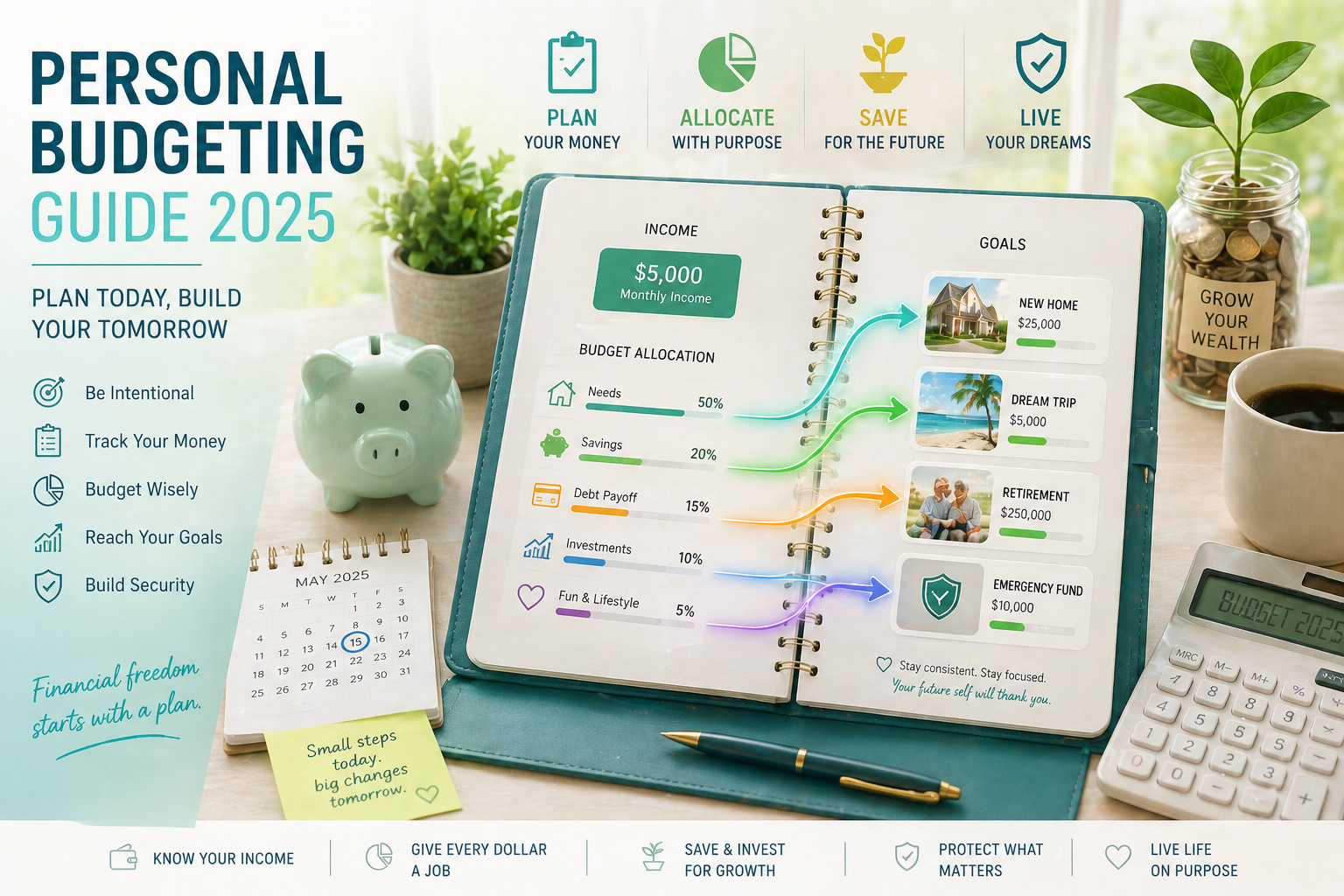
Most people know they should budget. Far fewer actually do it consistently — and even fewer do it in a way that genuinely changes their financial trajectory. The gap between knowing and doing comes down to one thing: most budgeting advice is either too rigid, too complicated, or too disconnected from real life to sustain long-term. A budget built entirely around restriction feels like a punishment. A budget with no emotional connection to meaningful goals feels arbitrary. And a budgeting system that demands an hour of careful spreadsheet work each week gets abandoned by week three.
This guide takes a different approach. You will learn the most effective personal budgeting frameworks for 2025, how to choose the right one for your personality and income type, the tools that make execution frictionless, and the psychological strategies that turn budgeting from a dreaded chore into the most powerful financial habit you own.
Why Budgeting Is the Foundation of All Financial Success
Every financial goal — paying off debt, building an emergency fund, investing for retirement, saving for a house — begins with one prerequisite: knowing where your money goes and intentionally directing it toward what matters most. Without a budget, spending is reactive. With one, it becomes proactive. This shift from reactive to proactive money management is where financial transformation begins.
Research consistently shows that people who budget accumulate significantly more wealth over their lifetimes than comparable non-budgeters, controlling for income. The mechanism is straightforward: budgeting creates awareness, awareness creates choice, and choice — exercised consistently — creates outcomes. High income without intentional spending habits frequently leads to lifestyle inflation and zero net worth. Modest income with disciplined budgeting can lead to financial independence.
Why Most People Fail at Budgeting
Before diving into how to budget effectively, it helps to understand why most budgeting attempts fail. Research in behavioral economics has identified several consistent patterns:
- Over-restriction: Budgets that leave no room for enjoyment feel like punishment. Humans are not wired for perpetual deprivation, and budgets built entirely around cutting spending create a sense of scarcity that leads to inevitable abandonment — often followed by revenge spending.
- Complexity paralysis: Tracking 30 spending categories across multiple spreadsheets is mentally exhausting. Most people give up within weeks when the system demands more attention than the results seem to justify.
- Irregular income challenges: Standard budgeting advice assumes a predictable monthly paycheck. Freelancers, entrepreneurs, and gig workers — a rapidly growing segment of the workforce — need fundamentally different approaches that account for income variability.
- Lack of emotional connection: A budget disconnected from your actual goals feels arbitrary. Knowing that you are cutting coffee to fund a dream vacation or early retirement changes the psychological calculus completely. The “why” behind a budget is as important as the mechanics.
- All-or-nothing thinking: Many budgeters abandon their entire system after one bad month or one impulsive purchase. Treating a budget as a rigid contract rather than a flexible plan leads to this pattern. A budget is a guide, not a prison sentence.
The Four Most Effective Budgeting Methods in 2025
1. The 50/30/20 Rule
The 50/30/20 rule divides after-tax income into three broad categories: 50% for needs (housing, food, transportation, utilities, minimum debt payments), 30% for wants (dining out, entertainment, travel, subscriptions), and 20% for savings and debt repayment beyond minimums.
Its strength is simplicity. You do not need to track individual transactions in granular detail — just maintain rough awareness of which bucket your spending falls into. Its weakness is that the 50% needs allocation can be unrealistic in high cost-of-living cities where rent alone may consume 40–45% of take-home pay. In those cases, adjusting to a 60/20/20 or 65/15/20 split while maintaining the savings habit is more practical than abandoning the framework entirely.
Best for: Beginners who want a simple framework with minimal tracking. People who find detailed transaction monitoring unsustainable.
2. Zero-Based Budgeting
Zero-based budgeting (ZBB) assigns every dollar of income a specific job until your income minus your allocations equals exactly zero. This does not mean spending everything — it means that money not spent on living expenses is explicitly allocated to savings, investments, or debt payoff before the month begins. Every dollar has a destination. Nothing goes to vague “leftover” spending.
ZBB is the most detailed and intentional of the major budgeting methods, and research consistently shows it produces the strongest financial results for people who implement it faithfully. The trade-off is that it requires genuine monthly planning — typically 20–30 minutes per month — and a willingness to adjust categories when unexpected expenses arise. Apps like YNAB (You Need a Budget) are specifically designed around this methodology and have built a devoted following among serious budgeters.
Best for: People who want maximum control and intentionality with their money. Those with specific financial goals they want to hit aggressively.
3. Pay Yourself First
The pay-yourself-first approach flips the traditional budgeting equation. Instead of spending first and saving whatever remains — which typically results in nothing remaining — you automatically transfer a predetermined percentage of your income to savings and investments the moment you are paid. What remains after savings is yours to spend however you choose, with no guilt, no tracking, and no judgment.
This method works exceptionally well for people who find detailed budget tracking tedious but who have the discipline to set a meaningful savings rate upfront. The key is making the savings transfer automatic and directing it toward specific goals: retirement accounts, an emergency fund, a house down payment, or an investment portfolio. Read more about building these income streams in our guide on Passive Income Streams 2025.
Best for: People with adequate income who struggle with tracking but can commit to a savings rate. High earners who want financial discipline without administrative overhead.
4. The Envelope System (Digital Version)
Originally a cash-based system where you physically placed money in labeled envelopes for different spending categories, the envelope method has evolved powerfully for the digital age. Apps like Goodbudget and Mvelopes replicate the psychology digitally: when your restaurant envelope is empty, you stop eating out — or consciously transfer money from another envelope, forcing a deliberate trade-off decision. This constraint creates exactly the kind of mindful spending pause that distinguishes intentional financial behavior from autopilot.
The envelope system is particularly effective for controlling specific problem spending categories without requiring a complete overhaul of your financial life. If dining out and online shopping are your weak spots, creating tight digital envelopes for those categories alone can produce significant savings with minimal behavioral change required elsewhere.
Best for: People with specific overspending categories they want to control. Visual thinkers who benefit from seeing finite category limits.
Building Your Emergency Fund: The Non-Negotiable Foundation
No budgeting system is complete without an emergency fund — a liquid cash reserve dedicated exclusively to unexpected expenses: job loss, medical bills, car repairs, or home emergencies. Without one, any financial shock sends you straight to high-interest debt, unraveling months of careful budgeting progress in a single week.
The standard recommendation is 3–6 months of essential living expenses. If your monthly necessities total $3,500, you need $10,500–$21,000 in fully liquid savings. For those with variable income, self-employment, dependents, or specialized careers with long job search timelines, targeting the higher end of this range is wise. For a detailed breakdown of how much you actually need in your specific situation, see our article on Emergency Fund 2025.
Where to keep your emergency fund matters almost as much as having one. A high-yield savings account (HYSA) is the right answer for most people — these accounts currently offer 4–5% annual yields at FDIC-insured institutions while keeping your money fully liquid. Keeping an emergency fund in a checking account earning 0.01% is leaving hundreds of dollars per year on the table. See our guide on High-Yield Savings Accounts 2025 for current top options.
The Best Budgeting Apps and Tools in 2025
- YNAB (You Need a Budget): The gold standard for zero-based budgeting. Subscription-based (~$15/month or $99/year) but users report average savings of $600 in their first two months and over $6,000 in their first year. Best for people who want maximum intentionality and are willing to invest a small amount of time monthly for dramatically better results.
- Mint / Credit Karma: Free, automatic spending tracking with bank account aggregation. Best for beginners who want a low-effort overview of their finances without manual input. Weaker for goal-directed budgeting but excellent for awareness building.
- Monarch Money: A premium, beautifully designed alternative with strong collaboration features for couples and families. Clean interface, excellent custom reporting, and good investment tracking. ~$15/month.
- Personal Capital (Empower): Best for investors who want to track both budgeting and net worth in one integrated platform. Free tools with optional paid wealth management services. Particularly strong for tracking investment accounts alongside spending.
- Copilot: An AI-powered iOS budgeting app that automatically categorizes transactions and learns your spending patterns. Particularly well-regarded for design quality and user experience.
- Spreadsheets: Never underestimate a well-designed Google Sheets or Excel budget template. Many serious personal finance practitioners prefer spreadsheets for their flexibility, full customization, and the cognitive engagement that manual entry creates — manually entering transactions builds spending awareness in a way automatic categorization does not.
Budgeting With Irregular Income
If your income fluctuates month to month — as a freelancer, consultant, business owner, or commission-based employee — traditional budgeting advice largely does not apply. The assumption of a predictable monthly paycheck underlies most standard frameworks. Here is a framework designed specifically for variable income:
- Base your budget on your lowest expected monthly income from the past 12 months. This creates a conservative floor that your essential expenses must fit within, ensuring you can always cover basics even in low-income months.
- Create an income buffer account. Route all income into a dedicated buffer account and pay yourself a fixed “salary” each month. In high-earning months, the buffer grows; in lean months, it absorbs the shortfall. This smooths the psychological volatility of variable income and makes budgeting far more predictable.
- Prioritize quarterly tax savings first. Self-employed individuals and freelancers must set aside 25–30% of gross income for taxes before budgeting anything else. Failing to do this consistently is the single most common and costly financial mistake among self-employed people — it results in devastating tax bills that derail financial progress.
- Triage any above-floor income. When income exceeds your baseline, allocate the surplus with intention: additional savings, debt payoff, investment, or building the buffer further. Never let variable-income windfalls disappear into lifestyle spending without explicit allocation.
The Debt-Investment Decision: One of Budgeting’s Most Important Choices
One of the most consequential decisions embedded in any budget is how to split discretionary dollars between debt repayment and investment. The mathematically optimal answer depends on the interest rate of your debt relative to your expected investment returns.
As a general framework: always capture your full employer 401(k) match first — it is an immediate 50–100% guaranteed return that no investment can match. After that, high-interest debt (above 7–8% interest) should typically be paid aggressively before additional investing, because the guaranteed “return” of eliminating 22% credit card interest exceeds the expected return of most investment strategies. Below that threshold, the math generally favors investing in the market over paying extra toward low-interest debt like mortgages or student loans at 4–5%.
For detailed strategies on handling high-interest debt, see our guide on Credit Card Debt: How to Pay It Off Fast. For building your credit profile while managing debt, see How to Improve Your Credit Score 2025.
The Psychology of Spending: Understanding Your Financial Triggers
Understanding your personal spending triggers is as important as any budgeting spreadsheet. Research consistently shows that most discretionary overspending is emotionally driven — triggered by stress, boredom, social comparison, or reward-seeking after difficult days. Recognizing these patterns does not eliminate them, but it creates the brief pause necessary to make a conscious choice rather than an automatic one.
Practical behavioral tactics that work: implement a 24-to-48-hour rule for non-essential purchases over $50 — most impulse desires fade within a day; unsubscribe from retailer email lists and delete saved payment information from shopping apps to increase purchase friction; use cash or a dedicated debit card for problem spending categories to create psychological separation; and schedule a brief weekly money check-in (10–15 minutes) to maintain awareness without obsessing over every transaction.
One powerful reframe: instead of asking “Can I afford this?” ask “Is this the best use of this money given my goals?” The first question only screens for financial capability. The second question screens for value alignment — and it is far more likely to produce decisions your future self will appreciate.
Budgeting as a Couple: Navigating Money Together
Money disagreements are consistently cited as a leading cause of relationship conflict and a primary driver of divorce. Establishing a shared budgeting framework and regular financial check-ins early in a relationship is one of the most important investments couples can make. Key principles for successful shared budgeting include: complete financial transparency (no hidden accounts or secret spending), equal voice in budget decisions regardless of income disparity, shared ownership of financial goals, and individual spending “fun money” allocations that each partner controls freely without accountability — typically $100–500 per month depending on income.
Apps like Monarch Money, Honeydue, and YNAB all offer strong joint budget management features designed specifically for couples or households sharing finances.
Frequently Asked Questions
What percentage of my income should I save?
Financial planners typically recommend saving at least 20% of gross income. If that is not currently possible, start with whatever you can — even 5% — and increase by 1% every few months until you reach 20%+. The habit of saving consistently matters more than the percentage when you are starting out. Automating the transfer on payday ensures savings happen before lifestyle spending can absorb the funds.
Should I pay off debt or invest first?
The math generally favors paying off high-interest debt (above 7–8%) before investing beyond your 401(k) match. Below that threshold, investing in a diversified stock portfolio is statistically likely to outperform the interest savings from extra debt payments. Always capture your full employer 401(k) match first — it is a guaranteed 50–100% return that no other financial move can compete with.
How do I stick to a budget long-term?
Connect your budget to specific, emotionally meaningful goals. A budget tied to a clear vision — owning a home, retiring early, traveling for three months — is dramatically more sustainable than one built purely around restriction. Review your goals monthly alongside your numbers to maintain motivation. Also: build in flexibility. A budget with a dedicated “fun money” allocation requires far less willpower than one that prohibits all discretionary spending.
How do I budget when I have an unpredictable income?
Use your lowest monthly income from the past year as your budget base. Create an income buffer account where all income is deposited and from which you pay yourself a fixed monthly “salary.” Prioritize tax savings (25–30% of gross for self-employed) and emergency fund building above all other goals. Surplus months build the buffer; deficit months draw it down.
How often should I review my budget?
A brief weekly check-in (10–15 minutes) combined with a fuller monthly review is the optimal cadence for most people. The weekly check-in maintains awareness and catches overspending before it compounds. The monthly review adjusts categories, evaluates goal progress, and plans ahead for upcoming irregular expenses like insurance premiums, annual subscriptions, or holiday spending.
Conclusion
A budget is not a constraint on your life — it is a plan for it. The right budgeting system, applied consistently, is one of the most powerful tools available for building financial security, reducing money-related stress, and making real, measurable progress toward the life you actually want. The best budget is always the one you will actually use — simple enough to maintain, flexible enough to adapt, and connected enough to your values to stay motivating over time.
Choose a method that fits your personality, automate your savings before spending begins, review regularly, and give yourself permission to adjust when life changes. Financial health is a practice built over years of consistent small decisions, not a destination achieved in a single dramatic month. For further reading, explore our guides on Financial Literacy, High-Yield Savings Accounts 2025, and How to Improve Your Credit Score 2025.