
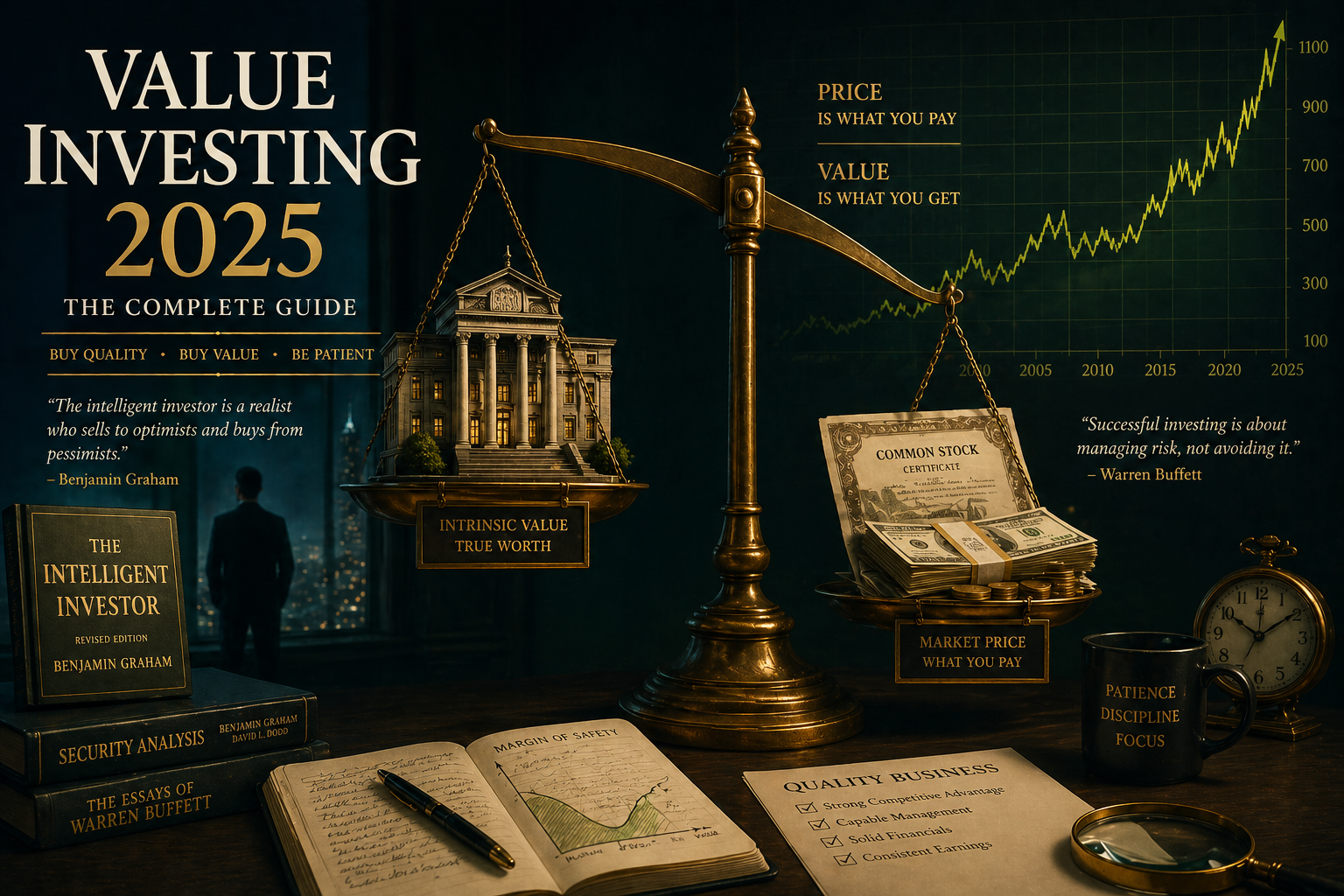
In a world obsessed with the next hot stock tip, viral social media trades, and AI-powered trading algorithms, value investing stands apart as a philosophy built on something radical: patience, discipline, and the willingness to buy what others are ignoring. Pioneered by Benjamin Graham and elevated to legendary status by Warren Buffett, value investing has produced some of the greatest investment returns in history — not through complexity or access to exclusive information, but through a deceptively simple idea: buy businesses for less than they are worth, and wait.
This comprehensive guide walks you through what value investing is, the intellectual framework behind it, the key metrics professionals use to identify undervalued stocks, how to apply the strategy in 2025’s market environment, and the psychological challenges that separate successful value investors from those who simply buy cheap stocks and call it a day.
What Is Value Investing?
Value investing is an investment strategy that involves buying stocks trading below their intrinsic value — the true, underlying worth of the business based on its assets, earnings power, and future cash flows. Value investors believe that stock markets are frequently irrational in the short term, pricing good businesses too cheaply when sentiment turns negative and overpricing mediocre businesses when optimism runs high.
By buying when prices are meaningfully below intrinsic value and holding patiently until the market corrects its mispricing, value investors aim to generate superior long-term returns with reduced permanent capital loss risk. The key word is permanent — temporary price declines are not losses; they are opportunities. Permanent capital loss — buying a business that deteriorates irreversibly — is the true enemy of value investors.
The concept was formalized by Benjamin Graham in his landmark books Security Analysis (1934) and The Intelligent Investor (1949), still considered the foundational texts of value investing. Warren Buffett, Graham’s most famous student, refined the approach by incorporating the importance of business quality: not just buying cheap businesses, but buying excellent businesses at fair prices. His partner Charlie Munger was instrumental in this evolution, famously advising Buffett to “forget what you know about buying fair businesses at wonderful prices. Instead, buy wonderful businesses at fair prices.”
The Intellectual Foundation: Mr. Market and the Margin of Safety
Mr. Market: The Most Important Metaphor in Investing
Benjamin Graham’s most enduring contribution to investment thinking may be the metaphor of Mr. Market. Imagine that you own a stake in a business with a rational, stable partner. Every single day, Mr. Market offers to buy your stake or sell you his at a quoted price. Sometimes Mr. Market is optimistic about the future and offers an absurdly high price. Other times, he is depressed and fearful, offering to sell at a ridiculously low price. Crucially, you are under no obligation to trade — you can simply ignore his daily quotes and wait until he offers a price that reflects what the business is truly worth.
The key insight is that Mr. Market is your servant, not your guide. His daily price quotes should inform you of opportunities, not dictate your emotions or decisions. Most investors do the opposite — they allow Mr. Market’s moods to become their own, buying enthusiastically when he is optimistic (at high prices) and selling fearfully when he is depressed (at low prices). Value investors do the reverse.
Intrinsic Value: What Is a Business Really Worth?
The cornerstone of value investing is intrinsic value — an estimate of what a business is truly worth based on its fundamentals, independent of current market price. Calculating intrinsic value is more art than science, involving discounted cash flow (DCF) analysis, comparable company valuations, and asset-based assessments.
The most rigorous method is the Discounted Cash Flow model: estimate how much free cash flow the business will generate over the next 10–20 years, then discount those future cash flows back to their present value using an appropriate discount rate (typically 8–12%, reflecting the investor’s required return). This present value is the intrinsic value. If the stock price is significantly below this estimate, the stock is potentially undervalued.
Different analysts will arrive at different intrinsic value estimates, and that is normal. The goal is not precision — it is a reasonable range that provides clarity on whether a stock is cheap, fair, or expensive. As Buffett has noted, “it is better to be approximately right than precisely wrong.”
Margin of Safety
Benjamin Graham introduced the concept of margin of safety: only buying a stock when it trades at a significant discount to your estimated intrinsic value — typically 25–40% or more. This discount acts as a buffer against errors in your analysis, unexpected business setbacks, or simply being wrong about the future. Even if your DCF assumptions are too optimistic by 20%, a 40% margin of safety ensures you still do not overpay.
The margin of safety is the single most important risk management tool in value investing. It is the difference between a speculative bet and a calculated investment with asymmetric risk — one where the downside is limited (because you are already paying below fair value) and the upside is substantial (when the market eventually recognizes the business’s true worth).
Key Metrics Value Investors Use
Price-to-Earnings Ratio (P/E)
The P/E ratio compares a stock’s price to its earnings per share. A P/E of 15 means investors are paying $15 for every $1 of annual earnings. Value investors typically look for stocks with P/E ratios that are low relative to the company’s own history, its industry peers, and the broader market. In 2025, the S&P 500’s average P/E is approximately 22–25, meaning stocks trading at P/E ratios of 10–15 with stable earnings and decent businesses may represent genuine value opportunities.
Important nuance: P/E should be evaluated relative to growth. The PEG ratio (P/E divided by earnings growth rate) provides context — a P/E of 15 on a business growing earnings at 15% per year is arguably cheaper than a P/E of 10 on a business with flat or declining earnings.
Price-to-Book Ratio (P/B)
The price-to-book ratio compares market price to the accounting book value of a company’s net assets. Graham famously favored stocks trading below book value — essentially paying less than the liquidation value of the company’s assets. While pure asset-based valuation is less relevant for modern service and technology businesses (which carry little physical asset value), P/B remains useful for banks, insurance companies, and industrial businesses with significant tangible asset bases.
Price-to-Free-Cash-Flow (P/FCF)
Many modern value investors prioritize free cash flow over reported earnings, as earnings can be influenced by accounting choices while free cash flow — what the business actually generates in cash after maintaining and growing its asset base — is harder to manipulate. A price-to-FCF ratio below 15 can indicate a business generating real cash that is underpriced by the market, particularly in capital-light industries where free cash flow closely approximates true economic earnings.
Enterprise Value-to-EBITDA (EV/EBITDA)
EV/EBITDA is widely used by professional investors because it accounts for a company’s debt load (enterprise value = market cap + net debt) and removes the distortions of different capital structures, tax rates, and depreciation policies. It allows cleaner comparisons across companies with different leverage profiles. A ratio below 8–10x is often considered potentially undervalued, depending on the industry and growth profile.
Return on Equity (ROE) and Return on Invested Capital (ROIC)
ROE measures how efficiently a company uses shareholder capital to generate profits. Buffett consistently looks for businesses with ROE above 15% sustained over multiple years — evidence of a durable competitive advantage that allows the company to generate high returns without excessive leverage. ROIC (return on invested capital) is an even more comprehensive measure, capturing returns on both equity and debt capital, and is particularly valuable for assessing businesses with significant debt. A company sustaining ROIC above its cost of capital creates economic value over time; one below it destroys value regardless of accounting profits.
Competitive Moats: The Quality Dimension of Value Investing
Modern value investing — especially in the Buffett tradition — places enormous weight on the concept of a competitive moat: a durable structural advantage that protects a business from competition and allows it to generate superior returns on capital for extended periods. Understanding moat sources is essential for distinguishing businesses worthy of investment from those that are merely temporarily cheap.
The five primary sources of competitive moats are:
- Network effects: The product or service becomes more valuable as more people use it. Credit card networks, social media platforms, and marketplaces exhibit this property. Visa processes transactions across billions of merchants and cardholders; any competitor must replicate both sides of that network simultaneously, making displacement nearly impossible.
- Switching costs: The cost (financial, psychological, or operational) of switching to a competitor is high enough that customers stay even if marginally better alternatives exist. Enterprise software, banking relationships, and supply chain management systems generate powerful switching cost moats.
- Cost advantages: The ability to produce goods or services at lower cost than competitors, either through scale economies, proprietary processes, or advantaged access to inputs. Walmart’s logistics infrastructure and Costco’s membership model generate cost advantages that new entrants cannot replicate.
- Intangible assets: Brands, patents, regulatory licenses, and proprietary data that competitors cannot easily replicate. Coca-Cola’s brand, pharmaceutical companies’ patent portfolios, and regulated utilities’ operating licenses are examples.
- Efficient scale: Markets where the economics only support one or a few players, deterring new entrants. Water utilities, pipeline operators, and local oligopolies often exhibit this characteristic.
Where to Find Undervalued Stocks in 2025
Value opportunities tend to cluster in specific situations that create artificial selling pressure or sentiment-driven pricing:
- Sector-wide pessimism: When investor sentiment turns negative on an entire sector — as happened with energy stocks during the peak of the renewable energy narrative — fundamentally strong companies often get swept down indiscriminately. Patient investors who buy quality businesses during sector-wide pessimism have historically been well rewarded as sentiment normalizes.
- Temporary earnings disappointments: If a fundamentally sound company misses one quarter’s earnings estimates by a narrow margin, the stock may drop 15–25% in a single day. When the underlying competitive position and long-term earnings power have not changed, this market overreaction creates a compelling entry point.
- Spin-offs and corporate restructurings: When large companies spin off divisions, institutional investors often sell the new entity reflexively because it does not fit their investment mandate or is too small for their portfolio guidelines. This indiscriminate selling frequently creates undervalued opportunities in the spun-off entity.
- International markets: European, Japanese, and select emerging market stocks often trade at significant valuation discounts to U.S. equities, reflecting lower investor enthusiasm and home-country bias rather than universally inferior business quality.
- Index deletions: When a stock is removed from a major index, index funds are forced to sell regardless of valuation. This mechanical selling pressure can create temporary undervaluation in businesses with unchanged or improving fundamentals.
Value Investing vs. Growth Investing: The False Dichotomy
The conventional framing of “value vs. growth” investing is fundamentally misleading. Buffett himself has argued repeatedly that growth is simply a component of value — a fast-growing business generating high returns on capital may be deeply undervalued even at a high P/E ratio if its future earnings are large enough. The true distinction is not between “cheap stocks” and “expensive growth stocks” — it is between investors who are disciplined about what they pay for a business and those who buy regardless of price.
The best opportunities frequently arise at the intersection of quality and value: high-quality businesses with strong competitive moats, excellent management, and durable growth prospects that are temporarily available at reasonable or below-average valuations due to market overreaction, sector pessimism, or temporary business headwinds. This “quality at a fair price” approach — sometimes called GARP (Growth at a Reasonable Price) — blends value discipline with quality awareness and has historically been the most consistently rewarding approach for individual investors. For related reading on growth assets, see our analysis on Cryptocurrency vs. Traditional Investment.
The Psychological Challenges of Value Investing
Value investing is psychologically demanding in a specific and underappreciated way: it requires maintaining conviction in your analysis when the entire market, the financial media, and often your colleagues are telling you that you are wrong. Buying a stock that has fallen 40% because investors have abandoned it requires genuine comfort with being contrarian — which runs against deep human social instincts built over evolutionary history.
The discipline required is substantial and sustained. Value stocks can remain undervalued for months or years before the market recognizes their worth. During that period, momentum investors holding high-flying growth stocks may significantly outperform your portfolio, creating social pressure and self-doubt. Maintaining commitment requires a clearly written investment thesis, a long time horizon, and the intellectual honesty to distinguish “the market disagrees with me” from “I was actually wrong about the business.”
The most dangerous failure mode for value investors is not overpaying — it is falling into value traps: businesses that look cheap by conventional metrics but are structurally declining, facing permanent competitive disruption, or carrying hidden liabilities that only become apparent over time. Identifying genuine value requires understanding the qualitative business picture as deeply as the quantitative metrics.
A Practical Value Investing Checklist
Before committing capital to any value investment, consider working through this systematic checklist:
- What is the business’s competitive moat, and is it durable or weakening?
- What is the sustainable free cash flow the business generates, and at what P/FCF multiple am I buying it?
- What is management’s track record with capital allocation? Do they buy back stock at sensible prices, avoid value-destructive acquisitions, and invest in the business judiciously?
- What is the balance sheet situation? How much debt does the company carry, and can it service that debt comfortably through a business downturn?
- What has gone wrong to create this apparent opportunity? Is the problem temporary or permanent?
- What is my intrinsic value estimate, and what margin of safety does the current price offer?
- If I am wrong about the business improving, what is my downside? Is there a floor of asset value or cash generation that limits permanent loss?
Frequently Asked Questions
Is value investing still relevant in 2025?
Yes, though its relative performance versus growth investing has been uneven. Value significantly underperformed growth during the 2010s bull market driven by technology megacaps, then significantly outperformed during the 2022 rate-rising cycle. Long-term academic research across multiple countries and decades consistently shows that valuation discipline is one of the strongest predictors of future investment returns.
What is a value trap?
A value trap is a stock that appears cheap on traditional metrics but is cheap for a legitimate and lasting reason — declining business fundamentals, technological disruption, structural industry headwinds, or management that systematically destroys shareholder value. Distinguishing genuine value opportunities from traps is the hardest skill in this approach, requiring deep qualitative business analysis beyond the numbers.
How many stocks should a value investor hold?
Graham recommended holding 10–30 stocks for adequate diversification without over-diversification. Buffett has at times held highly concentrated positions — sometimes 40%+ of his portfolio in a single stock — when conviction is extremely high and the opportunity is exceptional. Most individual investors benefit from 15–25 positions across different sectors and geographies, ensuring no single mistake can permanently damage their financial position.
How long should I hold a value investment?
Buffett’s ideal holding period is “forever” for high-quality businesses. Practically, value positions should be held until: the business reaches or exceeds your intrinsic value estimate (and the margin of safety is gone), the business’s competitive position materially deteriorates, or a superior opportunity requires capital reallocation. Patience — sometimes measured in years — is a core competency for value investors. Short holding periods defeat the purpose of the strategy.
Conclusion
Value investing is not a system for getting rich quickly — it is a framework for thinking clearly about what you own and what you pay for it. In a market environment frequently driven by momentum, narrative, and speculation, the patient investor who buys quality businesses at meaningful discounts to intrinsic value occupies a genuinely advantaged long-term position.
The tools are relatively simple: understand the business, estimate its value, demand a margin of safety, and have the patience to wait for the market to recognize what you already understand. The discipline required to apply these tools consistently through periods of underperformance and market pressure is the real barrier to success — and the reason this strategy remains viable even when everyone knows about it. Explore complementary strategies in our guides on S&P 500 Investing Guide 2025, Index Funds vs. Active Funds, and Building Wealth in Your 20s.