
Your credit score is one of the most consequential three-digit numbers in your financial life. It determines whether you qualify for a mortgage, what interest rate you pay on a car loan, whether a landlord approves your rental application, and sometimes even whether an employer hires you for a specific role. A difference of just 100 points on your credit score can mean tens of thousands of dollars in extra interest paid over the life of a loan — or the difference between qualifying for your dream home and being turned away entirely.
The good news: credit scores are neither mysterious nor fixed. They are calculated by a well-documented formula with understood inputs, and with the right strategies consistently applied, most people can meaningfully improve their score within 3–12 months. This guide explains exactly how the system works, what moves the needle fastest, and what common mistakes silently hold millions of people back.
Why Your Credit Score Matters More Than You Think
Most people understand that credit scores affect loan approval and interest rates. Fewer realize how pervasive their impact is across virtually every major financial decision in adult life. Here is the full scope of what your credit score can affect:
- Mortgage rates: A borrower with a 760+ score may qualify for a 30-year fixed mortgage at 6.5%. A borrower with a 620 score might pay 8.0% or higher for the same loan. On a $350,000 mortgage, that difference amounts to over $130,000 in additional interest over 30 years.
- Auto loan rates: Prime borrowers might pay 5–6% on a car loan; subprime borrowers may pay 15–20%+ — adding thousands of dollars to the total cost of a vehicle.
- Rental housing: Most landlords and property management companies run credit checks as part of their application process. Poor credit can result in application denial, required cosigners, or higher security deposits.
- Insurance premiums: In most U.S. states, auto and homeowners insurance companies use credit-based insurance scores. Poor credit can increase premiums by 30–50% or more.
- Employment: While restricted in some states, employers in many industries — particularly financial services, government, and positions handling significant assets — conduct credit checks as part of the hiring process.
- Utility deposits: Utility companies may require larger security deposits or upfront payment from applicants with poor credit scores.
How Credit Scores Are Calculated
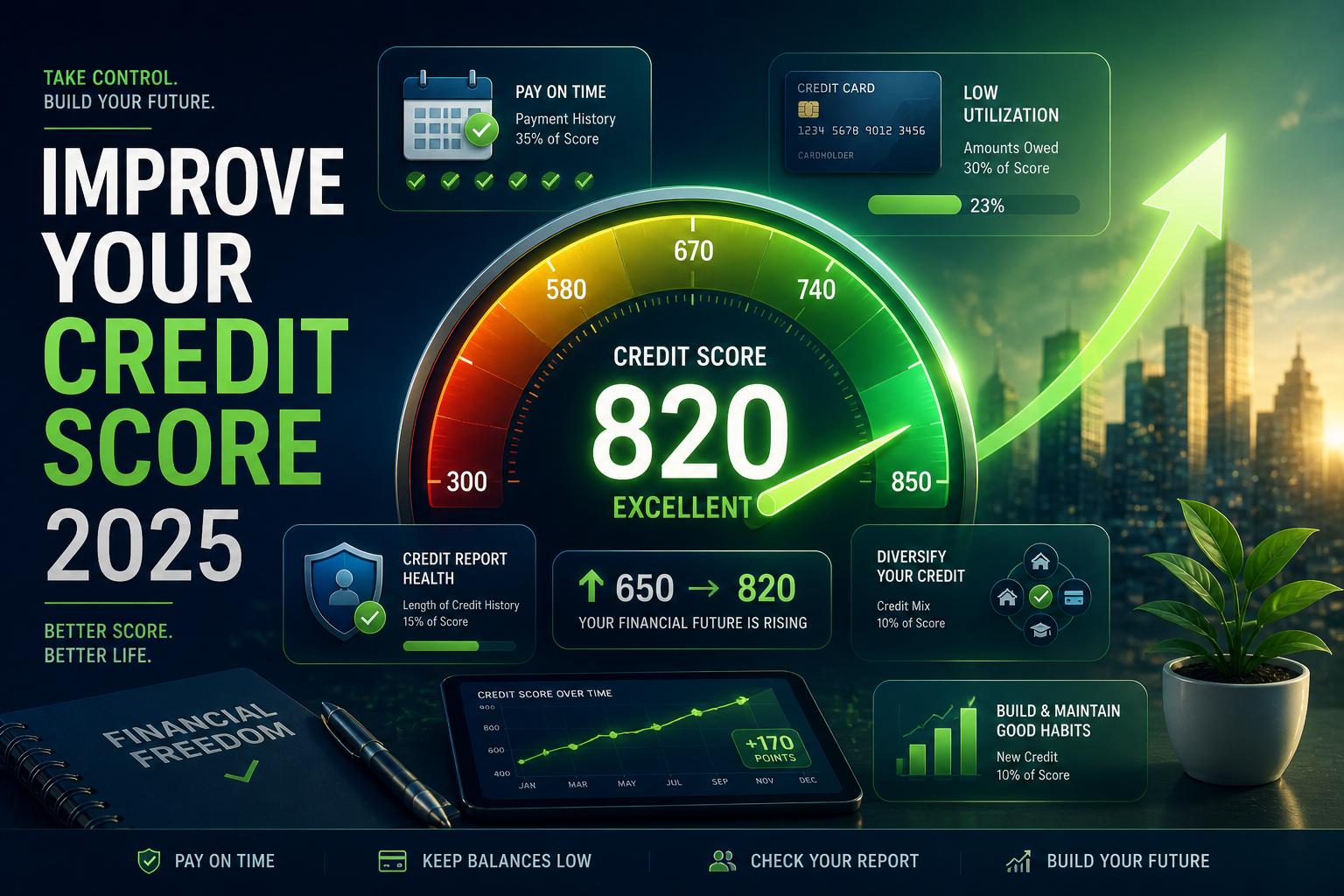
The dominant credit scoring model in the United States is the FICO score, which ranges from 300 to 850. Understanding its five components — and their relative weights — is the foundation of any credit improvement strategy. Each component can be targeted with specific actions:
- Payment history (35%): The single largest factor. Every on-time payment strengthens your score; every late payment damages it. A payment 30+ days late can drop your score by 60–110 points and remains on your report for seven years. Paradoxically, even one missed payment on an otherwise perfect record causes disproportionate damage.
- Credit utilization (30%): The ratio of your current revolving balances (credit cards) to your total available credit limits. Keeping this below 30% is commonly recommended; keeping it below 10% is optimal for the best scores. This factor updates monthly, making it one of the fastest to improve.
- Length of credit history (15%): Older accounts help your average account age. Closing old credit cards — even ones you never use — can shorten your average account age and hurt your score. Keep them open unless they carry an annual fee that exceeds the benefit.
- Credit mix (10%): Having a diverse mix of credit types (revolving accounts like credit cards, installment loans like auto or student loans, mortgage) demonstrates you can manage different forms of credit responsibly. You should not open new accounts solely for this purpose, but understanding the factor explains why a thin credit file with only one type of account scores lower.
- New credit inquiries (10%): Applying for multiple new credit accounts in a short period signals potential financial stress to lenders. Each hard inquiry (triggered by a credit application) typically reduces your score by 2–5 points for up to one year. Rate shopping for mortgages and auto loans within a 14–45 day window is treated as a single inquiry by FICO models.
Understanding Credit Score Ranges
- 800–850 (Exceptional): You qualify for the absolute best available rates on any loan product. Less than 20% of Americans achieve this range. Lenders view you as virtually zero risk.
- 740–799 (Very Good): You receive excellent rates, nearly identical to exceptional-range borrowers for most products. Roughly 25% of Americans fall here.
- 670–739 (Good): You qualify for most loan products but may not receive the absolute best rates. This is where the majority of American borrowers sit. The national average FICO score in 2025 is approximately 718.
- 580–669 (Fair): You will face higher interest rates and may be declined for premium credit products. Significant opportunity for improvement exists in this range.
- Below 580 (Poor): Qualifying for traditional loan products is difficult. Secured credit cards and credit-builder loans are typically the most accessible starting points for rebuilding.
The Fastest Ways to Improve Your Credit Score
1. Pay Down Credit Card Balances (Utilization Strategy)
Because credit utilization accounts for 30% of your score and updates monthly, paying down revolving balances is the single fastest lever most people have. If your total credit limit is $15,000 and you carry a $6,500 balance (43% utilization), paying it down to $1,400 (9% utilization) could improve your score by 30–60 points within a single billing cycle.
A powerful zero-cost tactic: request a credit limit increase from your card issuers without increasing your spending. If your limit increases from $6,000 to $10,000 and your balance stays at $1,500, your utilization drops from 25% to 15% instantly — without paying a single dollar. Most credit card issuers allow limit increase requests every 6–12 months online, often without a hard inquiry.
For maximum score optimization, spread your utilization across cards rather than maxing one. Having three cards each at 15% utilization scores better than having two at 0% and one at 45%, even if the overall utilization is similar.
2. Dispute Errors on Your Credit Report
Studies consistently find that a significant percentage of credit reports contain errors. The Consumer Financial Protection Bureau (CFPB) has reported that one in five Americans has an error on at least one of their three credit reports. Common errors include incorrect late payments that were actually paid on time, duplicate accounts, debts belonging to a family member with a similar name, and collection accounts that should have fallen off after seven years.
Under the Fair Credit Reporting Act (FCRA), you are entitled to one free credit report from each of the three major bureaus (Equifax, Experian, TransUnion) every year via AnnualCreditReport.com — the only federally authorized free report site. Review each carefully. Dispute any inaccuracies directly with the reporting bureau online or by certified mail. The bureau has 30 days to investigate and must remove information it cannot verify. Removing a single erroneous late payment can produce a dramatic score increase of 30–80+ points.
3. Set Up Automatic Payments for Every Account
Since payment history is 35% of your score, a single missed payment can cause catastrophic damage — especially on an otherwise clean record. The most effective prevention is complete automation. Set up automatic minimum payments on every credit account you hold. Even if you intend to pay the full balance manually each month, the automatic minimum ensures you never accidentally miss a due date due to a vacation, a busy period, or simply forgetting a login.
One important nuance: set the automatic payment to the minimum required — not the full balance — as the safety net. Then manually pay whatever additional amount you choose. This preserves the protection of automation while allowing flexible payment amounts.
4. Become an Authorized User on a Strong Account
If a family member or trusted friend with excellent credit is willing to add you as an authorized user on one of their oldest, highest-limit credit cards with a long history of on-time payments and low utilization, that account’s positive history will appear on your credit report. The benefit can be substantial — especially for people just starting to build credit or recovering from past mistakes.
You do not need to use the card, or even receive a physical card, to benefit from being an authorized user. The primary cardholder takes on no risk to their own score (unless you make purchases on their account and they miss payments as a result). This strategy can add 20–50+ points to a thin or recovering credit file.
5. Use a Secured Credit Card or Credit-Builder Loan
For those with limited or damaged credit, secured cards (backed by a cash deposit you provide that typically equals your credit limit) and credit-builder loans (where loan payments are reported to bureaus and funds are held until the loan is paid off) are proven tools for establishing positive payment history. Used responsibly for 12–24 months, they create the payment history foundation required for score improvement.
After 12–18 months of on-time payments on a secured card, most issuers will automatically upgrade you to an unsecured card and refund your deposit — often while increasing your credit limit simultaneously.
6. Experian Boost and Similar Programs
Experian Boost is a free program that adds on-time utility, phone, and streaming service payments to your Experian credit file — payments not traditionally included in credit scoring. For people with thin credit files, this can add 5–20 points to their Experian-based FICO scores instantly. Similar programs exist for other bureaus. While the impact is modest, it is entirely free and takes less than 10 minutes to set up.
Common Credit Score Myths Debunked
- Myth: Checking your own credit hurts your score. Completely false. Checking your own score is a “soft inquiry” with zero impact. Only hard inquiries — when a lender pulls your credit to make a lending decision — affect your score.
- Myth: Closing old credit cards improves your score. Usually false and frequently counterproductive. Closing an old account reduces your total available credit (raising overall utilization) and can shorten your average account age. Keep unused cards open unless they carry an annual fee that is not justified by rewards or benefits.
- Myth: Carrying a small balance improves your score. False. This myth has cost cardholders billions in unnecessary interest charges. Carrying any balance provides zero scoring benefit. Pay your balance in full every month — it eliminates interest charges and scores just as well as carrying a balance.
- Myth: Income affects your credit score. False. FICO scores are calculated entirely from your credit behavior, not your income. High earners with poor payment habits have low scores; modest earners who pay on time can have exceptional scores.
- Myth: Paying off a debt removes it from your report. Paid accounts remain on your report for up to 7 years (10 for bankruptcies). However, the account will be updated to show a zero balance and “paid” status, which improves your score even if the account history remains visible.
How Long Does Credit Repair Take? Realistic Timelines
The timeline for credit improvement depends on the nature and severity of the negative information:
- High utilization only: Paying down balances can improve your score within 1–2 billing cycles once the lower balances are reported to the bureaus. This is the fastest category of improvement.
- Recent late payments (less than 2 years old): With consistent on-time payments going forward, a meaningful recovery typically takes 12–24 months. The negative impact of late payments diminishes significantly as they age.
- Collection accounts: Paid collections have less impact than unpaid ones, especially under newer FICO models. Negotiating “pay for delete” agreements (where the collector removes the tradeline entirely in exchange for payment) is the ideal outcome. Unpaid collections remain for 7 years from the original delinquency date.
- Bankruptcy (Chapter 7): Remains on your report for 10 years. However, impact diminishes over time. With consistent positive credit behavior, reaching “good” credit (670+) within 3–4 years is achievable for many.
- Thin credit file (no credit history): Building from scratch to “good” credit (670+) typically takes 12–18 months with the right accounts and consistent on-time payments.
Managing Your Credit Through Major Life Events
Certain life events require proactive credit management to avoid score damage:
- Before applying for a mortgage: Avoid opening new credit accounts, making large purchases on credit, or changing jobs in the 6–12 months before your mortgage application. Any of these can temporarily lower your score or complicate underwriting.
- During divorce: Joint accounts become credit liabilities for both parties regardless of the divorce decree. Pay off and close joint accounts as soon as possible to prevent a former spouse’s late payments from damaging your credit.
- After job loss: Prioritize on-time payments above all other financial obligations. A late payment while unemployed is far more damaging to your long-term financial position than carrying a credit card balance temporarily.
Frequently Asked Questions
What is a good credit score?
A score above 740 is generally considered “very good” and qualifies you for the best available rates on most loan products. Above 800 is exceptional. For mortgage purposes specifically, 760+ typically qualifies for the best available mortgage rates from most lenders. The national average FICO score in 2025 is approximately 718.
How often should I check my credit score?
Monitoring your score monthly is a healthy habit and has zero impact on your score. Many credit cards now offer free credit score monitoring with real-time alerts for significant changes or potential fraud. Additionally, reviewing your full credit reports from all three bureaus at least annually is recommended to catch errors or fraudulent accounts before they cause lasting damage.
Can paying off a collection account improve my score?
Under newer FICO models (FICO 9 and 10) and VantageScore 4.0, paid collections are ignored in score calculation. However, many lenders still use older FICO models (FICO 8 or earlier) where even paid collections negatively affect scores. Negotiate “pay for delete” agreements where possible — request that the collector remove the tradeline entirely from your report as a condition of payment.
Does applying for multiple credit cards hurt my score?
Each application generates a hard inquiry reducing your score by 2–5 points for up to one year. Multiple applications in a short period signal potential financial stress to lenders. The impact is real but modest — most hard inquiries fall off your score calculation within 12 months. Strategic new account opening (one or two per year) is a reasonable approach for those focused on credit building.
Are credit repair companies worth using?
Generally no. Legitimate credit repair companies can only dispute inaccurate information on your report — which you can do yourself for free. No company can legally remove accurate negative information, regardless of what they promise. Be wary of any credit repair service that guarantees specific score improvements or charges fees before services are rendered.
Conclusion
Your credit score is not a reflection of your worth as a person — it is simply a snapshot of your recent credit behavior. And behavior can be changed. With consistent on-time payments, strategic utilization management, error disputes, and patience, virtually anyone can build a strong credit profile over time.
Start with the quick wins: check your report for errors, request credit limit increases, pay down high-utilization accounts, and automate every payment. Then maintain these habits for 12–24 months and watch your score steadily climb. For related financial health topics, explore our guides on Credit Card Debt: How to Pay It Off Fast, Personal Budget 2025, and Tax-Loss Harvesting 2025.