
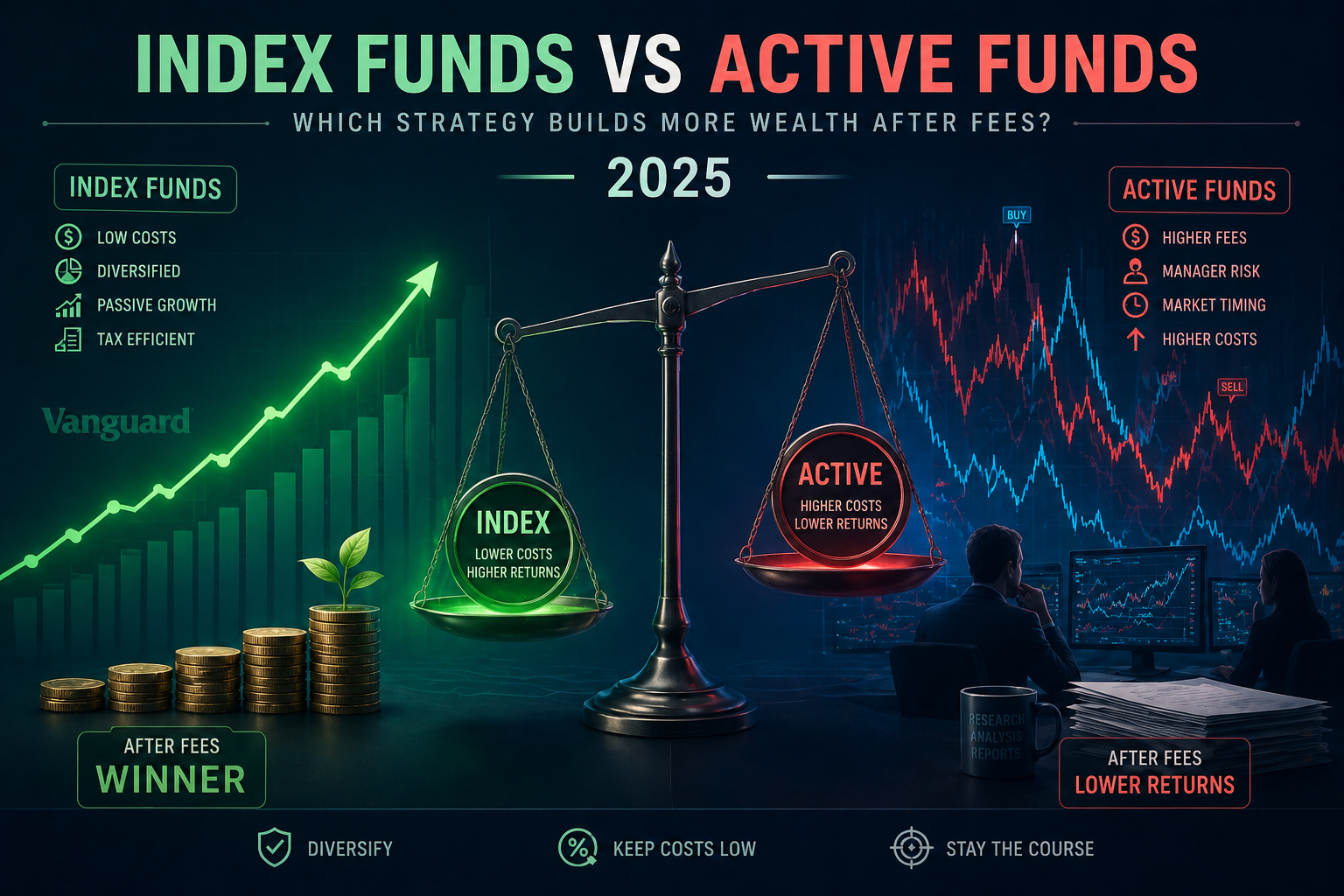
The debate between index fund investing and active fund management is one of the most consequential investment decisions an individual can make — and one of the most extensively researched topics in all of finance. At stake is not just a philosophical preference about investing style, but a mathematical reality backed by half a century of empirical evidence that consistently points in one direction. Understanding this evidence, and what it means for your specific situation, can make a meaningful difference in your long-term wealth.
This guide examines the index vs. active debate with data rather than ideology, explains the structural reasons why most active management fails to outperform after costs, identifies the narrow circumstances where active management can add value, and helps you design a portfolio strategy optimized for your goals and circumstances in 2025.
What Are Index Funds?
Index funds are investment vehicles designed to replicate the performance of a specific market index — such as the S&P 500, the total U.S. stock market, a total international stock market index, or various bond market benchmarks. Rather than employing analysts to research and select individual securities, index funds simply buy all (or a representative sample of) the securities in the target index, weighted proportionally to their index representation.
The result is a strategy that delivers the market return — no more, no less — at minimal cost. Expense ratios on leading index funds have fallen to extraordinary lows over the past decade, with Fidelity and Schwab now offering options at 0.015%–0.03% annually. On a $100,000 portfolio, this means paying $15–$30 per year in fees.
Index investing was pioneered by John Bogle, who launched the first retail index mutual fund through Vanguard in 1976. Initially derided by Wall Street as “Bogle’s folly” — the idea that investors would deliberately aim for average returns — index investing has since grown to command trillions in assets and is now the dominant investment philosophy among serious long-term investors and most sophisticated institutional investors.
What Are Actively Managed Funds?
Actively managed funds employ professional portfolio managers and research teams who analyze markets, evaluate individual securities, and make deliberate decisions about what to buy, hold, and sell. The goal is to outperform a benchmark index through superior security selection, sector allocation, or market timing. For this service, investors pay significantly more — expense ratios for actively managed equity funds average 0.60%–1.0% annually for traditional mutual funds, though lower-cost active ETFs have become more common.
The premise is appealing: skilled professionals with access to extensive research, industry contacts, and analytical tools should be able to identify opportunities and avoid pitfalls that passive indexes cannot. The question is whether they actually deliver on this premise consistently — and whether any outperformance they generate exceeds the higher costs investors pay to access it.
The Data: What 50 Years of Evidence Shows
The performance data on active vs. passive management is among the most extensively studied topics in financial economics — and the results are strikingly consistent across time periods, geographies, and asset classes. The S&P SPIVA (S&P Indices Versus Active) scorecard, published semi-annually since 2002, provides the most comprehensive ongoing comparison.
Key findings from the most recent 20-year SPIVA data:
- Approximately 95% of actively managed U.S. large-cap equity funds underperformed the S&P 500 over the 20-year period after fees.
- The underperformance rate for mid-cap funds was approximately 92% over the same period.
- For international developed market funds, approximately 90% underperformed their respective benchmarks.
- Even in emerging markets — where information advantages should theoretically be greater — over 85% of active funds underperformed over 15-year periods.
Equally important is the persistence problem: even the minority of active funds that outperform in one period rarely sustain that outperformance in the next. SPIVA data consistently shows that fewer than 10% of funds that ranked in the top quartile for performance in one five-year period maintained top-quartile performance in the subsequent five years — essentially random distribution. Past outperformance is not a reliable predictor of future outperformance, which makes identifying the rare genuinely skilled managers in advance nearly impossible.
Why Active Management Struggles: The Structural Reasons
The Arithmetic of Active Management
Nobel laureate William Sharpe formulated what is now called the “arithmetic of active management”: before costs, the average actively managed dollar must earn exactly the market return — because active managers collectively are the market. Some will outperform; for every dollar that beats the market, there must be a corresponding dollar that underperforms. After deducting fees averaging 0.7–1.0% per year, the average active fund necessarily underperforms the market by that fee amount. This is not a theory — it is mathematical certainty.
The Cost Headwind
The compounding impact of fees over time is dramatically larger than most investors realize. Consider two investors starting with $100,000, both earning 10% gross annual returns before fees, investing for 30 years:
- Index fund investor (0.03% expense ratio): Final value approximately $1,743,000
- Active fund investor (0.85% expense ratio): Final value approximately $1,309,000
The fee difference alone costs the active fund investor over $434,000 in final wealth — even assuming identical gross returns. In practice, the active fund also has a high probability of underperforming gross, making the real-world gap even larger. For more on cost-efficient investing, see our S&P 500 Investing Guide 2025.
Market Efficiency
Modern financial markets are extraordinarily efficient information-processing systems. Thousands of highly educated, well-resourced analysts compete to identify mispriced securities. Public information is reflected in prices almost instantaneously — within milliseconds for major announcements, within hours for most news. This efficiency makes it genuinely difficult to consistently identify opportunities that others have missed, not because fund managers are incompetent, but because their competition is equally skilled and similarly resourced.
Survivorship Bias
Reported performance data for active funds is systematically distorted by survivorship bias — the tendency for underperforming funds to be closed or merged into better-performing ones, removing their poor track records from the historical database. When researchers analyze the full universe of funds that existed at the start of a period — including those subsequently shuttered — active management underperformance looks significantly worse than headline figures suggest. Studies estimate survivorship bias inflates apparent active fund performance by 0.5–1.5% per year in published data.
Taxes and Turnover
Actively managed funds typically trade frequently — average annual portfolio turnover of 80–100% versus 3–5% for index funds. Each trade potentially generates a taxable capital gain distribution that must be paid by fund shareholders, regardless of whether they personally sold any shares. In taxable brokerage accounts, this tax drag can add 0.5–1.5% to the annual cost of active management, further widening the performance gap. Index funds, by contrast, rarely generate capital gain distributions due to their low turnover, making them significantly more tax-efficient in taxable accounts.
Where Active Management Can Still Add Value
While the evidence strongly favors indexing for most investors, active management is not uniformly inferior in every context:
- Less efficient markets: In markets with lower analyst coverage and higher information asymmetry — small-cap stocks, micro-cap stocks, emerging markets, frontier markets — the evidence for active outperformance is somewhat stronger, though still weak in absolute terms. Skilled active managers have more room to add value when competition is less intense.
- Fixed income specialty: In certain bond market categories — particularly high-yield corporate bonds, distressed debt, and niche credit markets — active management shows a better relative track record than in equity markets. Credit analysis and trading skill can provide a genuine edge in less liquid, less efficiently priced markets.
- Tax-managed strategies: Direct indexing and some active tax-managed strategies can generate meaningful after-tax alpha for high-income investors in taxable accounts through systematic tax-loss harvesting at the individual security level. The after-tax advantage can legitimately offset higher management fees for investors in the highest tax brackets.
- Alternatives and private markets: Private equity, venture capital, real estate, and hedge fund strategies that access markets unavailable to index funds can potentially add genuine diversification and return. However, access restrictions, high minimums, liquidity constraints, and fee structures require careful evaluation.
How to Build a Core Index Fund Portfolio
For most individual investors, a simple two-to-four-fund index portfolio covers the essential bases at minimal cost. Two widely recommended frameworks:
The Two-Fund Portfolio
A global stock market index fund (such as VT — Vanguard Total World Stock ETF, 0.07%) combined with a total bond market index fund (BND, 0.03%). This captures virtually all globally available equity returns in a single fund while the bond allocation moderates volatility. Simple, cheap, and extraordinarily diversified.
The Three-Fund Portfolio
Often called the “Lazy Portfolio” or “Bogleheads Three-Fund Portfolio,” this approach uses a U.S. total stock market fund (VTI, 0.03%), an international stock market fund (VXUS, 0.07%), and a bond fund (BND, 0.03%). By separating U.S. and international equities, investors can adjust their home country allocation independently. Many financial planners suggest 60–80% U.S. equities, 20–40% international, and a bond allocation equal to your age as a rough starting framework.
Factor Investing: Smart Beta
An increasingly popular approach is factor investing — using index-like low-cost funds that systematically tilt toward documented return factors: value, small-cap, momentum, quality, and low volatility. Academic research has shown these factors have historically produced higher returns than the market cap-weighted index over long periods. Funds like SCHD (dividend quality), VFVA (value), and AVUV (small-cap value) allow investors to access these factors at low cost without pure stock-picking. This represents a middle ground between pure indexing and active management.
The Core-Satellite Approach: Combining Both
Many experienced investors adopt what is called a “core-satellite” approach: using low-cost index funds as the core holding (typically 70–90% of the portfolio) while allocating a smaller portion to carefully selected active strategies, individual stocks, or alternative investments. This captures most of the cost and diversification benefits of indexing while maintaining some exposure to potential active outperformance without betting the entire portfolio on it.
The core-satellite approach is also psychologically useful for investors who find pure passive investing insufficiently engaging — maintaining a small active “play money” allocation satisfies the desire for stock-picking or market prediction without the portfolio-level consequences of going fully active. For income-focused variations on this framework, see our guide on Dividend Investing 2025.
How to Evaluate and Choose an Index Fund
Not all index funds are equal. Key factors to evaluate when choosing:
- Expense ratio: This is the single most important factor. Compare expense ratios carefully — a 0.05% difference compounds to tens of thousands of dollars over 30 years.
- Tracking error: How closely does the fund track its benchmark index? Lower tracking error indicates better execution. Most major index ETFs have tracking error below 0.05%.
- Assets under management (AUM): Larger funds tend to have tighter bid-ask spreads, better liquidity, and are less likely to be closed. Prefer funds with at least $1 billion in AUM.
- Tax efficiency: For taxable accounts, ETF structures are generally more tax-efficient than mutual funds due to the in-kind creation/redemption mechanism that avoids triggering capital gains distributions.
- Index methodology: Understand what the index tracks. The “S&P 500” and “total stock market” indexes include different companies and weighting approaches, affecting concentration and factor exposure.
Frequently Asked Questions
Can active funds ever beat index funds?
Yes — some active funds outperform in any given period, and a small number of genuinely skilled managers have demonstrated sustained outperformance over long periods. The challenge is identifying them in advance with any reliability. Past outperformance has essentially no predictive value for future performance. Most investors are better served by accepting market returns via low-cost indexing than gambling on identifying the rare outperforming active manager before the fact.
Is it too late to switch from active to index funds?
In tax-advantaged accounts (401k, IRA), switching from expensive active funds to index funds has no tax consequence and can be done at any time. In taxable brokerage accounts, switching may trigger capital gains taxes on appreciated positions. A tax advisor can help calculate whether the ongoing fee savings justify the immediate tax cost in your specific situation.
Should I use both active and index funds?
The core-satellite approach — index funds as the dominant core with limited active exposure — is a reasonable compromise for investors who want some active exposure without overexposing their portfolio to active management underperformance. Keep the active allocation small enough that even significant underperformance would not materially damage overall portfolio results.
What about Warren Buffett? He’s an active investor who beat the market for decades.
Buffett is an extraordinary outlier — almost certainly a genuinely superior investor rather than a lucky coin-flipper. However, he has consistently recommended that virtually all investors, including his own estate’s trustees, should invest in a low-cost S&P 500 index fund rather than attempting to emulate his approach. The skills required to replicate his success are extraordinarily rare, and the ability to identify another Buffett in advance is essentially nonexistent. Even Buffett himself achieved most of his returns through buying entire companies and insurance operations rather than through stock-picking alone.
Conclusion
The evidence accumulated over five decades of financial research consistently points in one direction: for most investors in most markets over most time periods, low-cost index funds outperform actively managed alternatives after fees. This is not an ideological claim — it is a mathematical and empirical conclusion driven by the unavoidable cost headwinds that active management faces, the efficiency of modern capital markets, and the impossibility of reliably identifying outperforming managers in advance.
This does not mean every investor should hold only index funds, or that active management has no role. But it does mean that the burden of proof rests with those advocating for active management, not with those advocating for passive indexing. And after decades of research, that burden has not been met except in narrow, specific circumstances. For the overwhelming majority of individual investors, a simple allocation of low-cost index funds, contributed consistently over decades, represents the highest-probability path to long-term financial success. See also our guides on Building Wealth in Your 20s, Personal Budget 2025, and Tax-Loss Harvesting 2025.